December 11, 2025
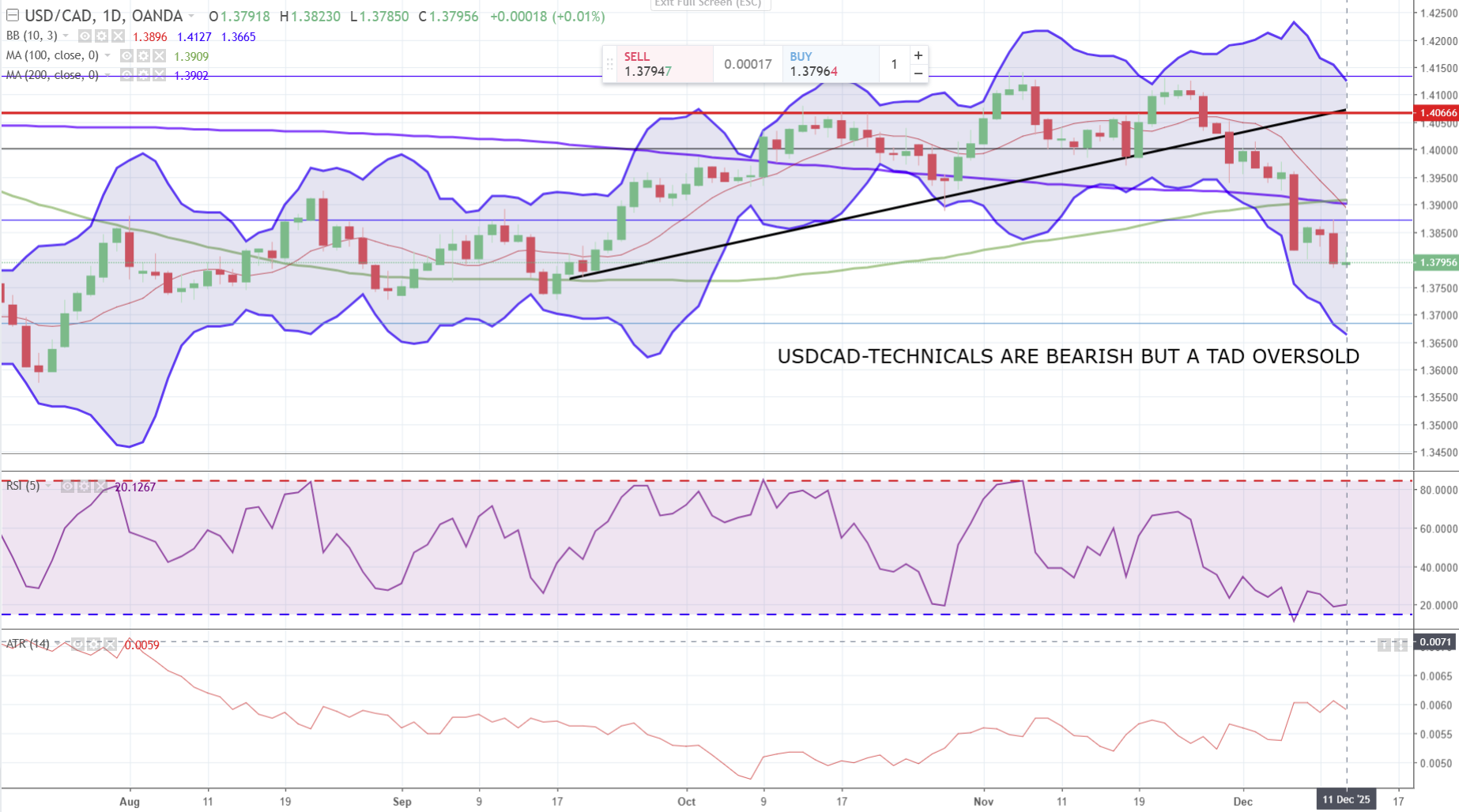
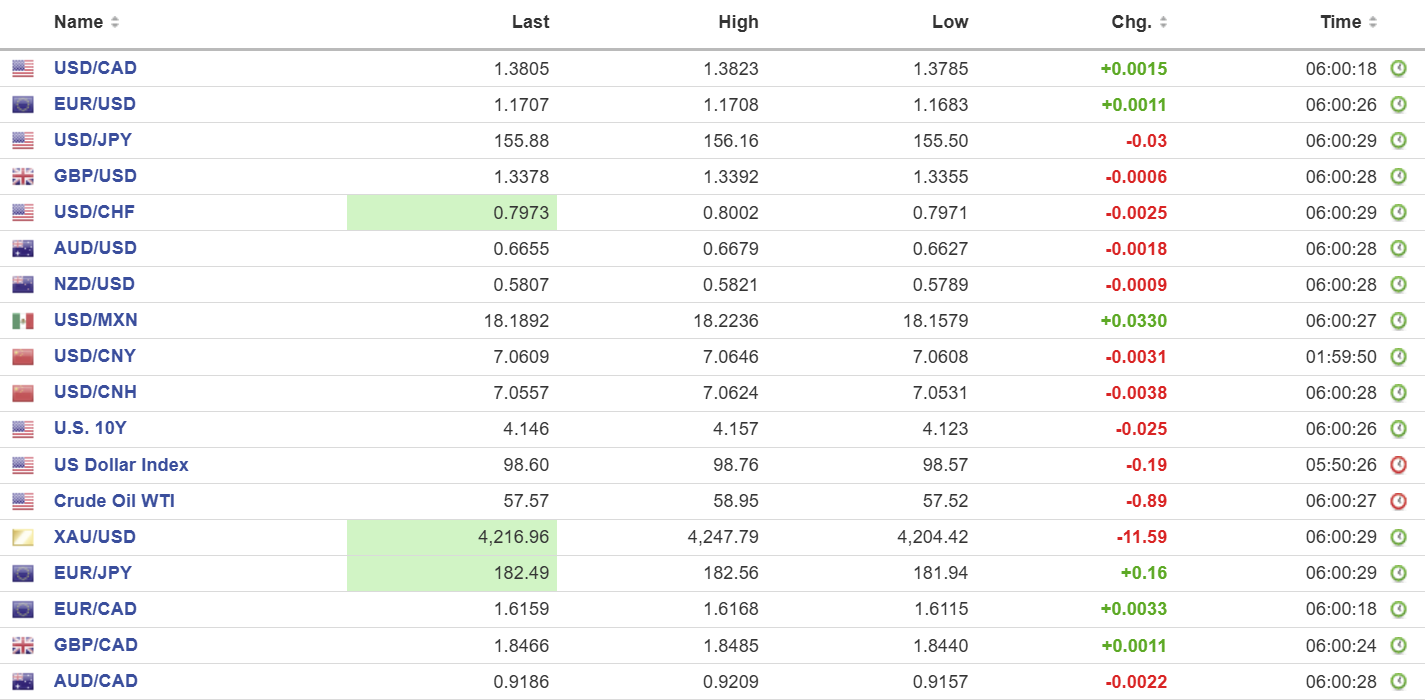
USDCAD open: 1.3805, overnight range 1.3785-1.3923, close 1.3794
USDCAD barely moved after the Bank of Canada kept rates unchanged, a decision everyone had already penciled in. Policymakers defended the pause by noting that inflation is unfolding in line with their projections, the labour market is showing some early signs of stabilizing, and the budget’s fiscal stimulus should provide support. Their outlook since the last meeting has not shifted. They still expect GDP to grow at a modest pace in 2026 and for inflation to hover near the target.
That stability changed after the FOMC left rates unchanged which was expected but the statement and press conference were less hawkish than expected which knocked the US dollar lower and USDCAD fell in sympathy.
WTI oil prices traded in a 57.52–58.95 range due to increased supply concerns after the US appeared to be bolstering its crude inventory by hijacking Venezuelan oil tankers.
USDCAD Technical Outlook
The intraday USDCAD technicals are bearish below 1.3830 (previous support) which is guarding the downtrend line from November 25 at 1.3880. A break below 1.3760 targets 1.3720, but the RSI is in oversold territory. Only a break above 1.3880 negates the downside pressure
The medium-term technicals are bearish supported by the move through the multi-week uptrend channel, and the drop through the major support zone in the 1.3950-80 area. The outlook remains bearish while the 100 day and 200 day moving averages at 1.3909 and 1.3902 cap gains.
For today, USDCAD support is at 1.3770 and 1.3750. Resistance is at 1.3830 and 1.3880
Todays Range 1.3770-1.3840
Fed Cuts, Dollar Falls
The Fed cut its benchmark rate to 3.75%, which was universally expected, but the decision was not unanimous. That was also expected. Trump’s man Miran was always going to want a 50 bp cut; however, two members, Chicago Fed’s Goolsbee and Kansas City’s Fed Schmnid, wanted to leave rates unchanged. Dissent makes for a good headline, but the reality is the dot-plot projections are little changed from September. The US dollar came under selling pressure in the wake of the meeting, but it has since recouped some of the losses.
US Employment Market Looks Healthy
The Fed cut rates because they thought the labour market need support but today’s weekly jobless claims data suggests that support may not be needed. Weekly jobless claims rose 236,000 and the four week average was steady at 216,700.
Taking Stock
Asian equity markets closed mixed due to the Fed decision and tech stock concerns after Oracle Corporation’s earnings missed estimates. Japan’s Topix fell 0.94%, Hong Kong’s Hang Seng was flat, and Australia’s ASX 200 rose 0.15%.
As of 7:15 am, European bourses are positive. The UK FTSE 100 is up 0.13%, the French CAC 40 has gained 0.26%, and the German DAX is flat. S&P 500 futures are down 0.34%, the US Dollar Index is 98.49, the U.S. 10-year Treasury yield is 4.135%, and gold (XAUUSD) is 4217.59.
EURUSD
EURUSD rallied post-FOMC and again overnight in a 1.1683–1.1713 range. Traders expect the Fed to continue to trim rates, while ECB rates are expected to remain unchanged for the foreseeable future. The dovish Fed outlook was reinforced after NEC Director (and rumoured next Fed Chair) Kevin Hassett said the Fed has plenty of room to cut rates. The Swiss National Bank (SNB) left its benchmark rate unchanged at 0 and forecast that inflation would dip to 0.3% from 0.5% next year.
GBPUSD
GBPUSD traded higher in a 1.3355–1.3392 band due to bearish US dollar sentiment following the FOMC decision. GBPUSD gains are hampered by expectations that the Bank of England will cut UK rates by 25 bps to 3.75% next Thursday.
USDJPY
USDJPY retreated from 156.16 to 155.50 overnight after hitting 156.97 post-FOMC. The losses occurred on the back of speculation that the FOMC was far less hawkish than anticipated. Expectations for a BoJ rate hike next week and fears of intervention helped cap gains.
AUDUSD
AUDUSD had a choppy session in a 0.6627–0.6679 range. Post-FOMC gains topped out at 0.6686; then a far weaker-than-expected employment report knocked AUDUSD to the floor. Australia lost 21,300 jobs rather than gaining 20,000, which was expected. However, the unemployment rate remained steady at 4.3%, which supported the RBA comment that “labour market conditions appear a little too tight.” That realization helped lift AUDUSD from its session low.
USDMXN
USDMXN has been on a rollercoaster as it rose and fell in an 18.1579–18.2236 range. The volatility was due to a mix of FOMC and tariff news. Mexico is planning on tariffs of up to 50% on China and other Asian nations in another win for Trump.
China
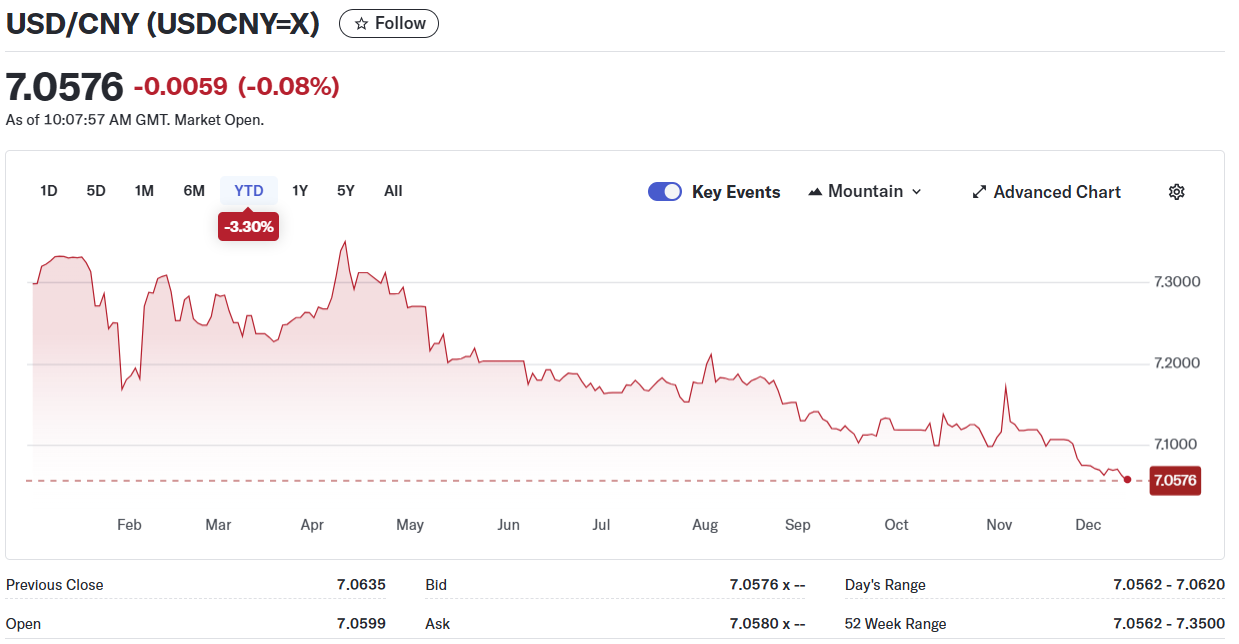
PBoC Fix: 7.0686 vs exp. 7.0525 (Prev. 7.0753)
Shanghai Shenzhen CSI 300 fell 0.86% to 4552.19
FX High, Low, Open
Sources: Investing.com, Bloomberg, Reuters, Yahoo Finance, US Census Bureau, Trading Economics