February 25, 2026
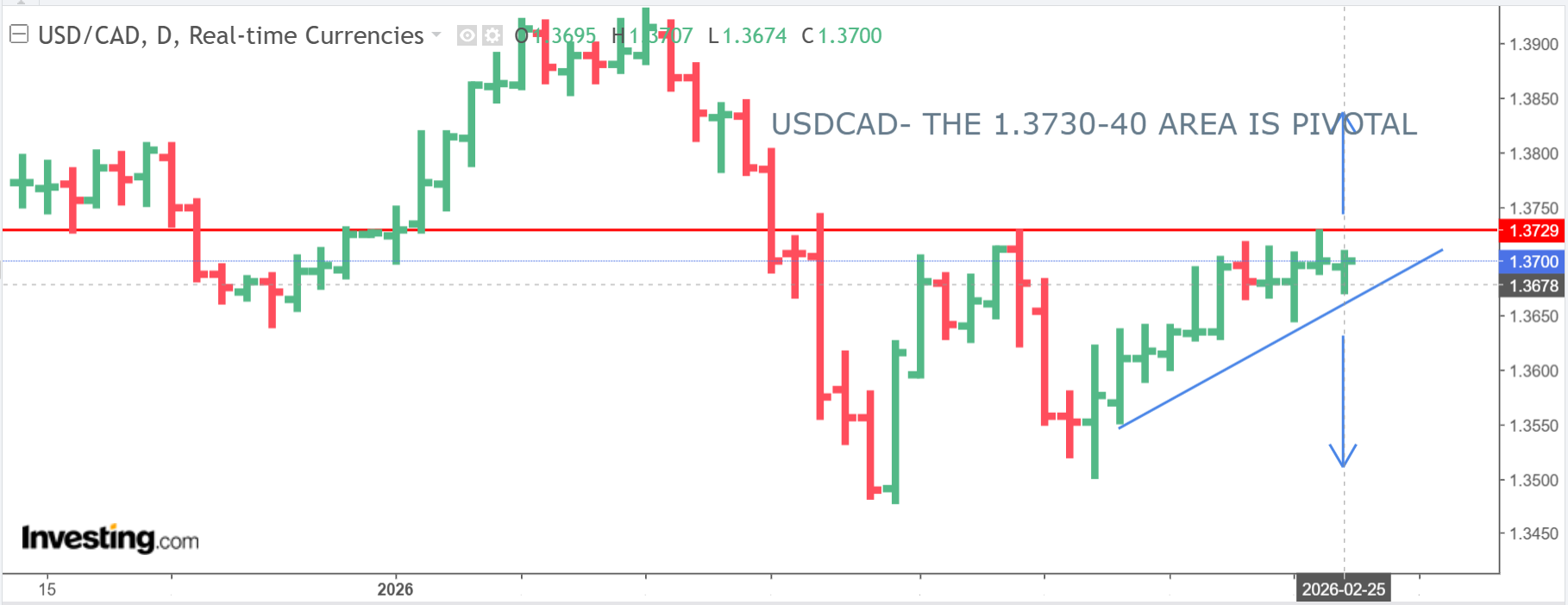
USDCAD open: 1.3699, overnight range 1.3674-1.3707, close 1.3700
USDCAD is ebbing and flowing with every shift in US dollar sentiment. The currency pair recouped its overnight losses in early NY trading in part because of US dollar safe-haven demand because of the risk that Trump attacks Iran.
USDCAD downside is limited due to uncertainty around the upcoming CUSMA negotiations. Trump has mused about scrapping it altogether but the Supreme Court ruling that his tariff strategy is illegal may change that.
WTI oil prices continue to see-saw and traded in a 65.46-66.57 range. API reported weekly crude inventories rose by 11.0 million barrels last week which helped to limit oil price gains. Trump did not really mention Iran in his speech last night and that gave some hope that hostilities would be averted.
The US and Canadian economic calendars do not have any top tier releases.
USDCAD Technical Outlook
The intraday USDCAD technicals are unchanged. They are bullish while trading above 1.3650 and targeting a break above 1.3730 for a test of the 1.3780–1.3800 resistance zone. The 1.3730-40 area is pivotal. A failure to break to the topside risks a drop below the uptrend line to 1.3550.
The medium-term technicals are bearish below 1.3780 leaving prices trapped within a 1.3480-1.3780 band. A break below 1.3550 would reopen downside risk toward 1.3400, while a sustained break above 1.3800 would argue for a move toward 1.3900 and potentially 1.4000.
For today, USDCAD support is at 1.3680 and 1.3650. Resistance is at 1.3740 and 1.3780.
Today’s Range: 1.3650–1.3740
Reality Distortion Verbiage
Trump’s State of the Union address was a big deal for Republicans hoping to curry favour with the President, but a painful waste of time for viewers.
For one hour and forty-eight minutes, Trump wove a fanciful tale of personal achievements and economic outcomes that occurred only inside his head. Global markets ignored the diatribe. They kept their focus on tech stock developments and the pending release of Nvidia’s quarterly earnings at the close of trading today.
Greenback Uneventful
The US dollar had another quiet session and opened in New York little changed from yesterday’s close. Trading is muted due to concern about how Trump will react to nations backtracking or ignoring his coerced tariff deals and US investment demands after his tariffs were declared illegal. In addition, a lack of actionable US top-tier data has sidelined traders.
Taking Stock
Asian equity markets followed Wall Street’s lead and rallied, led by a 1.17 percent gain in Australia’s ASX 200. Japan’s Topix gained 0.71 percent while the Hong Kong Hang Seng rose 0.66 percent.
As of 5:30 am, the UK FTSE 100 is leading Europe higher with a gain of 0.97%. The German DAX is up 0.46% and the French CAC 40 has gained 0.44 %. S&P 500 futures have risen 0.30%, the US Dollar Index is at 97.85, the 10-year Treasury yield is 4.052 percent, and gold (XAUUSD) is 5,188.10.
EURUSD
EURUSD is trading defensively in a 1.1771–1.1808 range. Eurozone inflation data came in as expected and was unchanged from December. German GDP grew 0.6 percent year over year in December, as expected. German Chancellor Friedrich Merz has joined a long line of world leaders making the trek to China to make nice and bolster bilateral trade as a defence against Trump’s trade war.
GBPUSD
GBPUSD traded choppily in a 1.3491–1.3534 range and is sitting just above the low in early New York trading. Prices are trading defensively after Bank of England Governor Andrew Bailey said yesterday that he would go into the March policy meeting “asking if a rate cut is justified.”
USDJPY
USDJPY is at the top of its overnight 155.35–156.82 range on fears that the BoJ will turn dovish and shelve its plans to normalize policy. The gains were further supported following news that Prime Minister Takaichi’s government nominated two people to the BoJ board to advocate monetary and fiscal stimulus policies to prop up the economy.
AUDUSD
AUDUSD rose then fell in a 0.7057–0.7117 range, with the peak seen in the aftermath of a higher-than-expected headline CPI reading, actual 3.8 percent year over year versus forecast 3.7 percent year over year, and the RBA’s trimmed CPI rising to 3.4 percent from 3.3 percent. The move did not last and AUDUSD has given up most of the gains.
USDMXN
USDMXN consolidated yesterday’s losses in a 17.1474–17.1951 range. Yesterday’s cooler-than-expected inflation numbers were not a factor. USDMXN peso direction continues to be dictated by trade concerns and general US dollar sentiment.
China
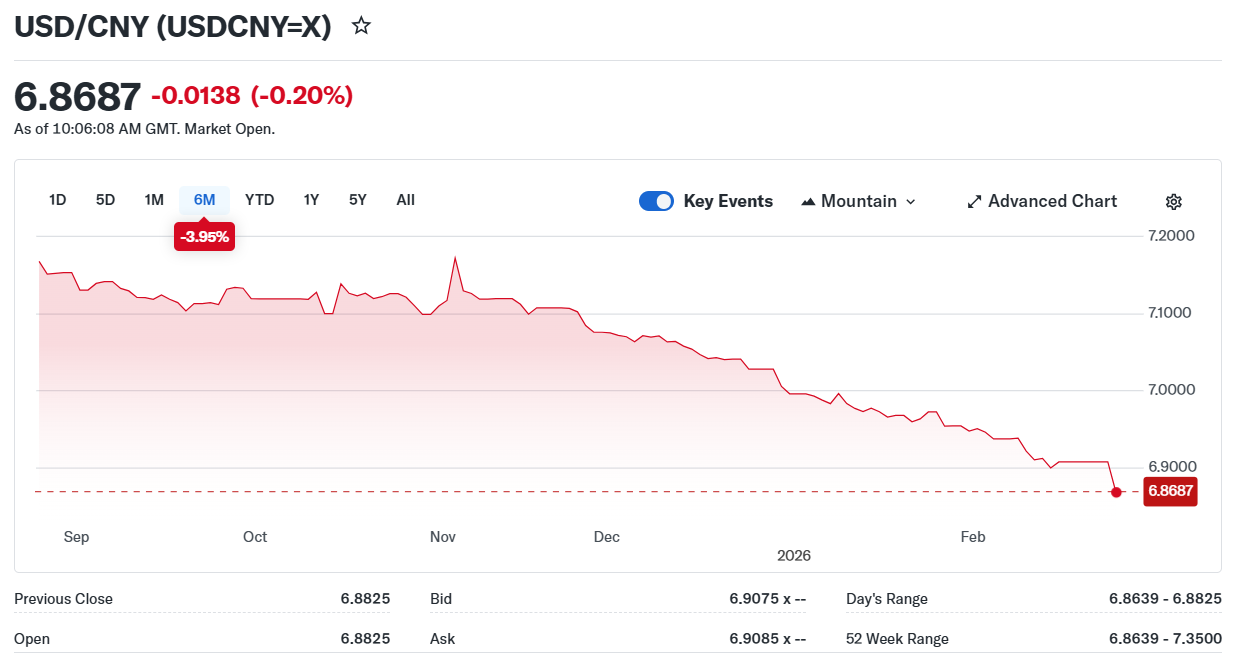
USDCNY Fix: 6.9341 versus expected 6.8824, previous 6.9414.
Shanghai Shenzhen CSI 300 rose 0.60 percent to 4,735.89.
USDCNH, the offshore yuan, is at its lowest level in three years, in part due to uncertainty around the US dollar stemming from Washington’s chaotic trade policies.
The IMF calls for China to step up its shift to a consumption-led growth model to curb its “unwarranted industrial policy” and help reduce its trade surplus.
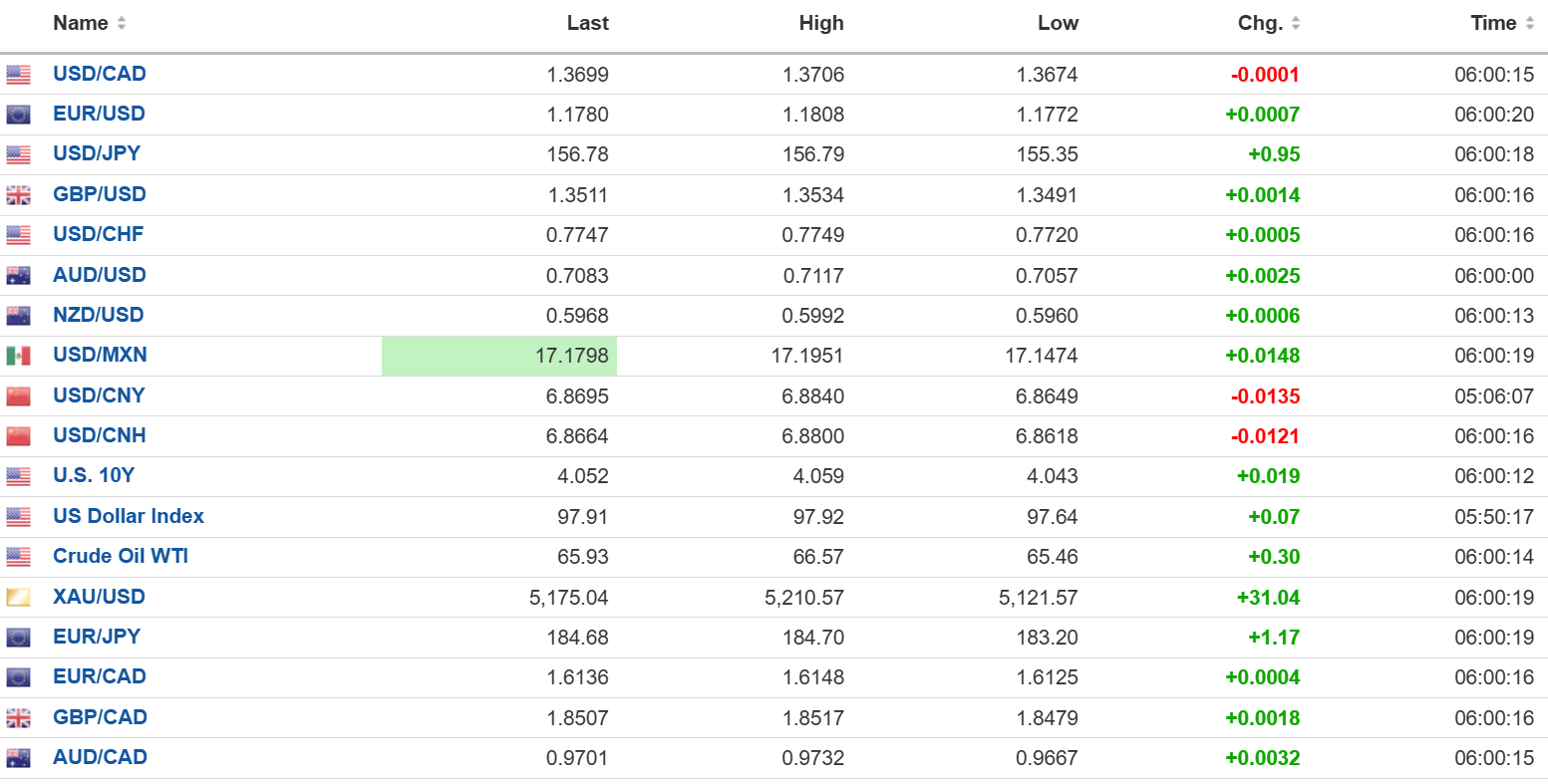
FX open high low
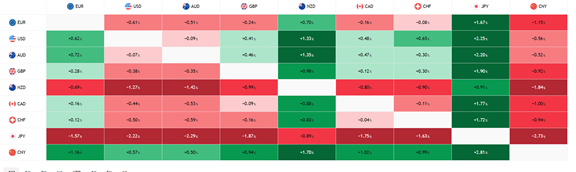
FX Heat Map (6:00 am) one week
Sources: Investing.com, Bloomberg, Reuters, Yahoo Finance, US Census Bureau, Trading Economics Tradingview