By Michael O’Neill
If Christmas is the season to be jolly, then the next four months is the season to avoid a market folly. There is an illusion of calm rippling through foreign exchange markets as traders maintain a “wait-and-see” approach to ever-shifting developments in Trump’s Iran war.
Trump has declared victory and announced an “indefinite ceasefire” pending further negotiations with Iranian leaders. Those discussions are a tad one-sided; the US makes a series of demands, but Iranian officials are not in attendance.
Even so, the Strait of Hormuz is effectively closed, and today Iran announced that it seized two vessels, even as the US Navy blockades Iranian ports.
The Glass is Half-Full
The Bank of Canada’s Q1 Business Outlook Survey, released on April 20, paints a cautiously optimistic picture. Business sentiment improved for a third consecutive quarter, clawing its way back toward pre-trade-conflict levels. Firms are hiring, investment intentions are picking up, and wage expectations are holding steady around 3.5%.
That’s the good news.
The less good news is that much of this data reflects a pre-war world. Follow-up calls conducted after the outbreak of Middle East hostilities show a sharp shift in tone. Input costs like energy, freight, fertilizer, and aluminum are on the rise, and firms are absorbing those increases rather than passing them through. That may keep headline inflation contained in the short term, but it points directly to margin compression ahead.
Meanwhile, the Consumer Outlook Survey tells a far more fragile story. Households are still struggling with elevated living costs, spending intentions remain muted, and job-loss fears are stubbornly high. Add in new anxiety from public sector workers and those exposed to AI disruption, and the picture becomes less about resilience and more about caution.
Put the two surveys together, and the message is that the economy is stabilizing, but it won’t take much to knock it off the rails. But until there is further evidence, Bank of Canada policymakers will be content to watch developments from the sidelines.
Seasoning the Loonie
Many believe that May heralds the onset of a few months of Canadian dollar strength. It is a popular rule of thumb, as over the past two decades, the Canadian dollar has drifted higher during the spring-summer window in roughly 11 of 21 tradeable years, or about 52% of the time with another four ending essentially flat. There were just six instances where the Canadian dollar sank.
Even narrowing the lens to the post-2015 period, when USDCAD developed a more persistent structural bid for the US dollar, CAD still strengthened in six of eleven summers, with two sideways outcomes and only three clean losses.
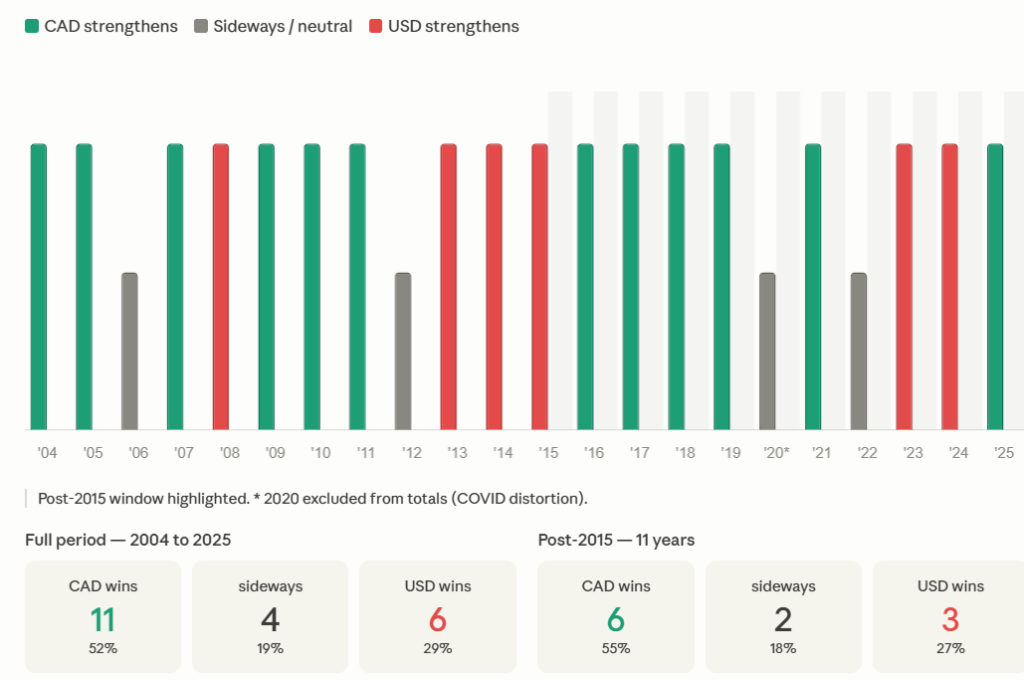
The current backdrop appears to favour Canadian dollar strength. The US dollar index is well below its US/Iran war peak and trending lower. Safe-haven demand for dollar trades are being unwound as optimism for an end to the Middle East crisis rises. Oil prices have scope to fall further if the ceasefire holds, which will boost global economic growth, improve risk sentiment, and put additional downward pressure on the US dollar.
Rules of Thumb are Made to be Broken
The problem is that the conditions most likely to make the seasonal trade work in 2026 are also the conditions most at risk of unravelling.
The Canada-US-Mexico Agreement on trade (CUSMA) renegotiations are heating up fast, and Canada’s Chief Trade Negotiator has already warned Canadians to expect turbulence. It is already getting nasty. The Americans are reportedly demanding concessions before talks even begin, what is being described as an “entry fee” just to get in the room, while negotiations with Mexico have moved beyond preliminary talks to formal proceedings starting May 25. Canada is not Mexico, and the divergence in timelines is not a flattering signal for the loonie.
Furthermore, Trump may be willing to walk away from Iran, but the damage is done. The Iranian Revolutionary Guard Corps has demonstrated that it can hold the world’s most critical oil chokepoint hostage with minimal assets.
The Fed Chair transition is another wild card. Rep Thom Tillis plans to block Kevin Warsh’s confirmation until the Department of Justice cancels or completes its investigation into Jerome Powell and the Fed. If not, Powell will remain Fed Chair, and that will seriously annoy Trump.
The old seasonal playbook says USDCAD should weaken into the summer. The current environment says it may be folly to believe so.