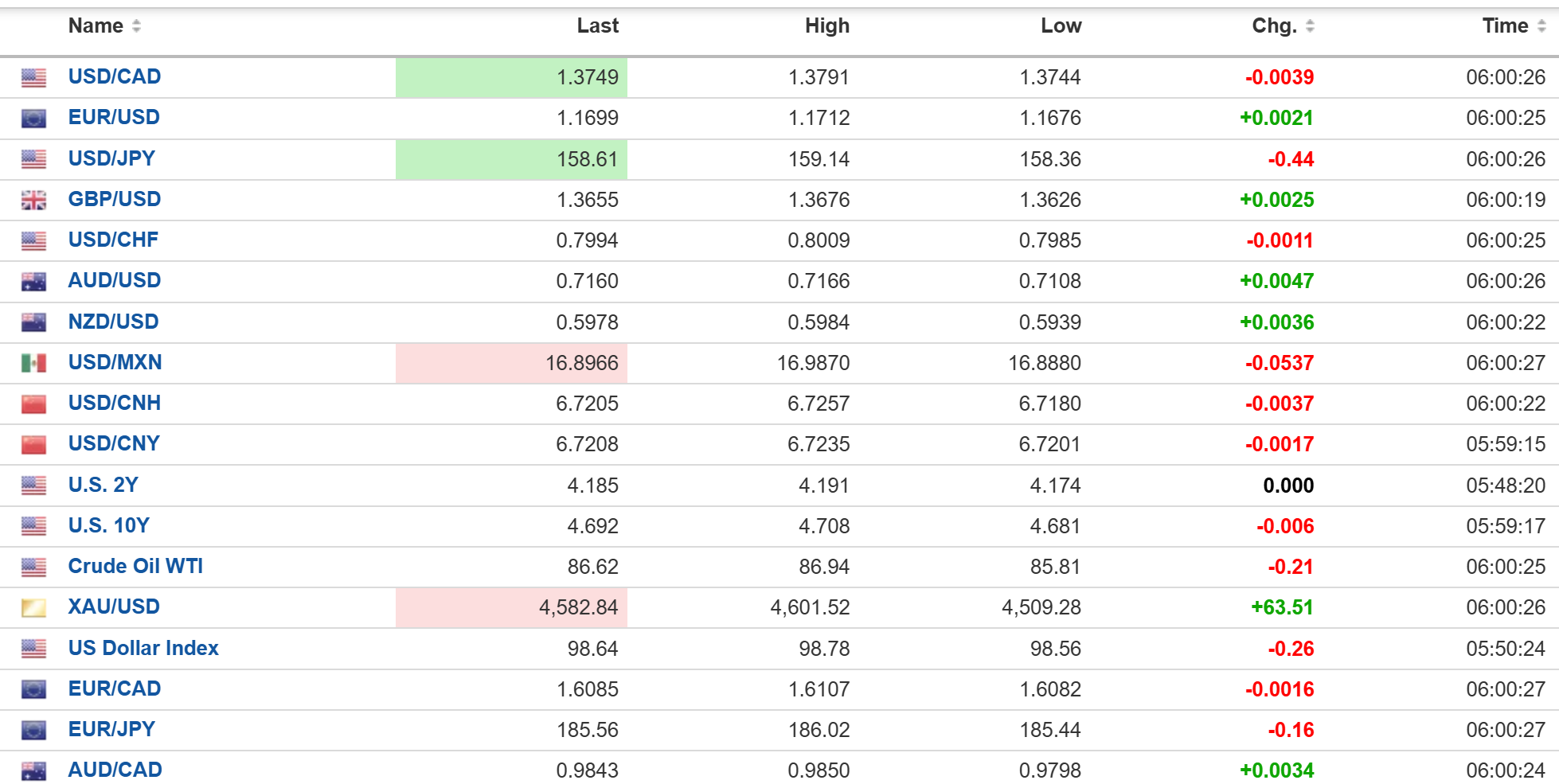
USDCAD open: 1.3749, overnight range 1.3744-1.3791, close 1.3789
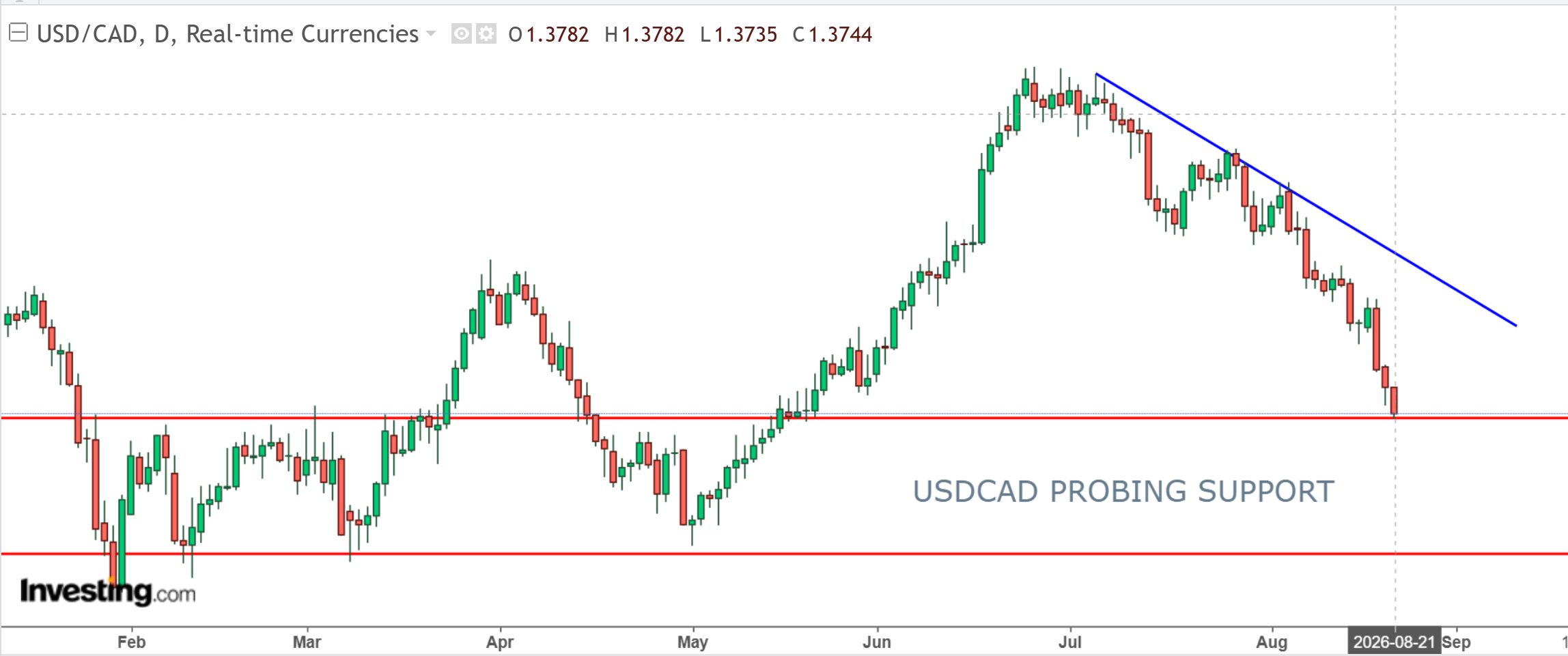
USDCAD continues to probe the significant technical support zone in the 1.3740-50 area and has lost 1.32% this week. The possibility of a Canada-US trade deal has absolutely nothing to do with the selling pressure.
The real culprit is the US Treasury. Take a bow, Mr. Bessent. He claimed that doubling the size of the 10-to-30-year bond buybacks was merely about restoring liquidity in thinly traded long-dated sectors. Global markets called “Bullcrap” as the move came just as total US debt surpassed $40.0 trillion, heightening anxiety over the broader US fiscal position. It was also seen as an overt attempt by Treasury to usurp control over US interest rates. He made the situation worse by suggesting the program could be increased.
The news knocked Treasury yields lower, but that move has been largely reversed while making alternatives to US investments far more attractive. Gold and cryptocurrency prices soared.
The Trump-imposed tariff deadline of 12:01 am August 22 is fast approaching. There are plenty of rumours and speculation about how it will shape up and if accurate, Canada got beaten up. US Vice President JD Vance mocked the Canadian Prime Minister, saying, “Carney tried to ‘out-tough’ Trump.” He went on. “It’s hilarious because Carney presents this as some victory for Canada when fundamentally, like, they climb down on a lot of issues.”
The Globe and Mail (and others) report that Canada will avoid the planned 50% tariff on cars (the current rate is 25%) and accept a 15% tariff on cars while US vehicles are exempt. That is a horrible deal. It gives the US auto industry breathing room to rebuild its manufacturing capacity, protect its workers from an economic shock and keep them employed heading into the midterm elections, all at the expense of Canadian workers and, ultimately, Canada’s auto industry.
Mark Carney has consistently maintained that “Canada will not accept a bad deal” or sign any agreement “whatever the cost.” Yet, if the auto tariff rumour is correct, that is exactly what he has done.
There is still hope. Ontario Premier Doug Ford and the other provinces can scupper any deal by leaving the US booze ban in effect.
WIT oil prices rose from 85.81 to 87.50 in early New York for an 8.3% gain since Monday due to US plans to escalate tensions with Iran. The Americans are planning a series of measures to target Iran and countries that it deals with ostensibly to prevent Tehran from obtaining a nuclear weapon. Ironically, America (and Trump) is exactly why Iran needs nukes. Furthermore, it is hard to see Trump’s idea of targeting countries that deal with Iran being successful, as China is its biggest customer.
Canada Retail Sales rose a tad more than expected in July, rising 0.6% m/m (forecast 0.4% and ex-autos, 0.5% (forecast 0.4%). Statistics Canada’s preliminary estimate for July has retail sales down 0.8%
USDCAD Technicals
The intraday USDCAD technicals are bearish following the break below support at 1.3770, a level that now reverts to resistance. A decisive break of 1.3735 targets the 1.3680-1.3700 area.
Longer term, the USDCAD downtrend accelerated after prices sliced through the 200-day moving average at 1.3848 and the 0.618 Fibonacci retracement of the May-June range at 1.3822 in quick succession. USDCAD is trading at the bottom of the daily 3 STD Bollinger band at 1.3734. A decisive break below the 0.786 retracement at 1.3700 area would expose chart support at 1.3670, and below that level, there is little in the way of a drop toward 1.3410.
NOTE: USDCAD has plunged 170 points in just two sessions, the daily RSI at 10 is at its most oversold reading of the year, and prices are stretched well below the Bollinger band. That combination is the classic setup for a violent short-covering bounce on any friendly headline. A corrective rebound could reach the 1.3825-1.3850 zone.
For today, USDCAD support is at 1.3720 and 1.3700. Resistance is at 1.3770 and 1.3820.
Today’s expected range is 1.3710-1.3790
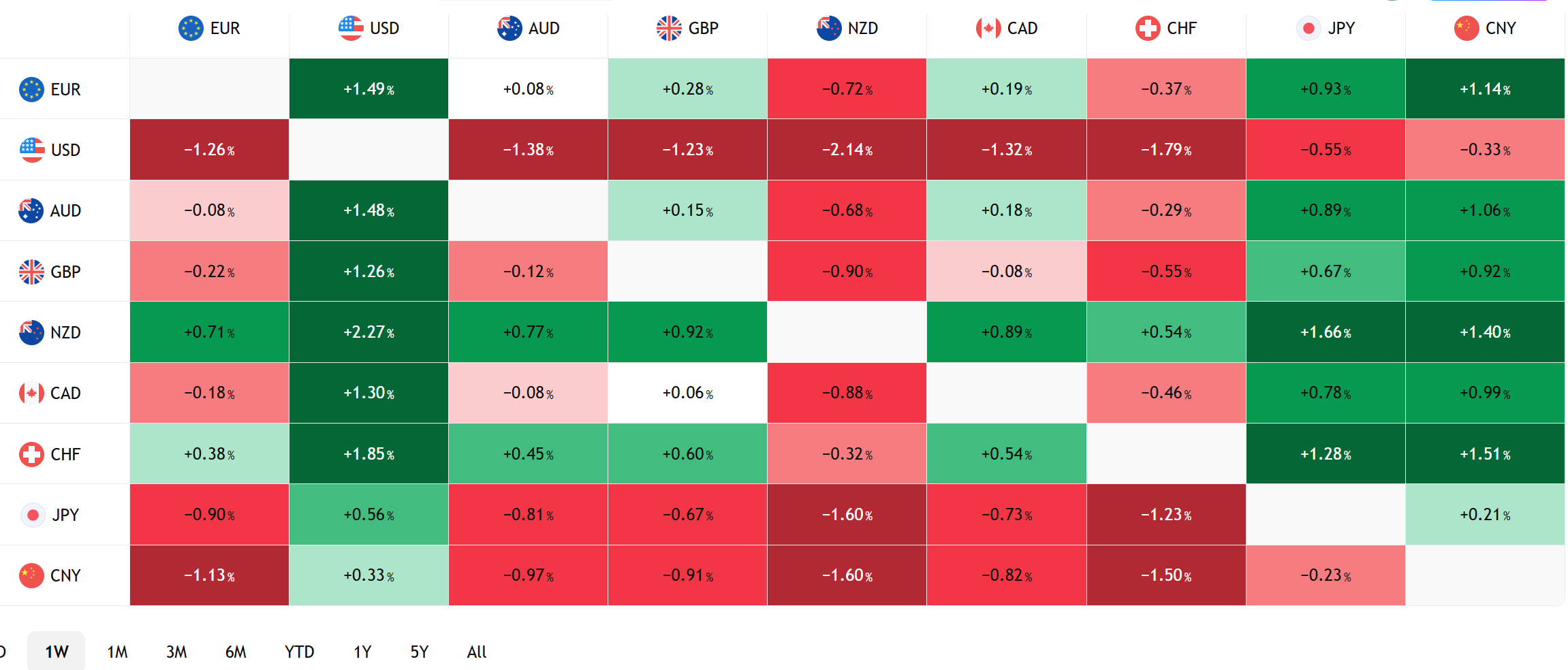
FX Heat Map
FX open high low 6:00 am
Taking Stock
Asian markets closed mixed. Hong Kong’s Hang Seng gained 1.21%, Japan’s Topix rose 0.19% while Australia’s ASX 200 fell 0.27%.
As of 5:30 am PT, the German DAX has gained 0.32%, the French CAC-40 is up 0.19% and UK FTSE 100 has risen 0.24%. S&P 500 futures are up 0.47%, the US 10-year yield is 4.696%, and gold is $4,569.66.
EURUSD | Range 1.1676-1.1712
EURUSD consolidated yesterday’s gains but with a small bid thanks to stronger manufacturing growth. Eurozone August PMI rose 52.8 compared to 51.9 in July. S&P Global Chief Business Economist Chris Williams wrote: “A sustained solid rise in business activity in August sets the eurozone up for a robust increase in third quarter GDP of around 0.3%. The manufacturing sector is again the star performer, enjoying its strongest growth for four-and-a-half years, with the services economy providing a supporting role.” The short term EURUSD technicals are bullish above 1.1620.
GBPUSD | Range 1.3626-1.3676
GBPUSD added to yesterday’s gains and is pushing above resistance in the 1.3660 area which capped gains since April’s rally from 1.3155. Bessent’s interest rate manipulation attempt has driven the US down across the board and given sterling a lift. Prices were also bolstered by improved consumer confidence data and a robust PMI report. Composite PMI rose to 52.5 from 52.2 which S&P Chief Economist Williams said suggests “solid economic growth of around 0.3% in the third quarter.” He added that the results should mean that the Bank of England keeps a hawkish bias.
USDJPY | Range 158.36-159.14
USDJPY traded with a negative bias on the back of broad US dollar weakness and robust July inflation numbers. National CPI, ex food and energy, rose 1.8% y/y compared to 1.7% previously.
AUDUSD | Range 0.7108-0.7170
AUDUSD continued to be underpinned by broad US dollar weakness as negative sentiment from the soft jobs report faded. The RBA maintains a hawkish bias but the jobs data eased the pressure.
USDMXN | Range 16.8880-16.9870
USDMXN continued to drift lower overnight and is close to the bottom of the range. The selling pressure from broad US dollar weakness got additional support when the Banxico policy meeting minutes suggest a long rate pause due to slowing inflation.
CHINA
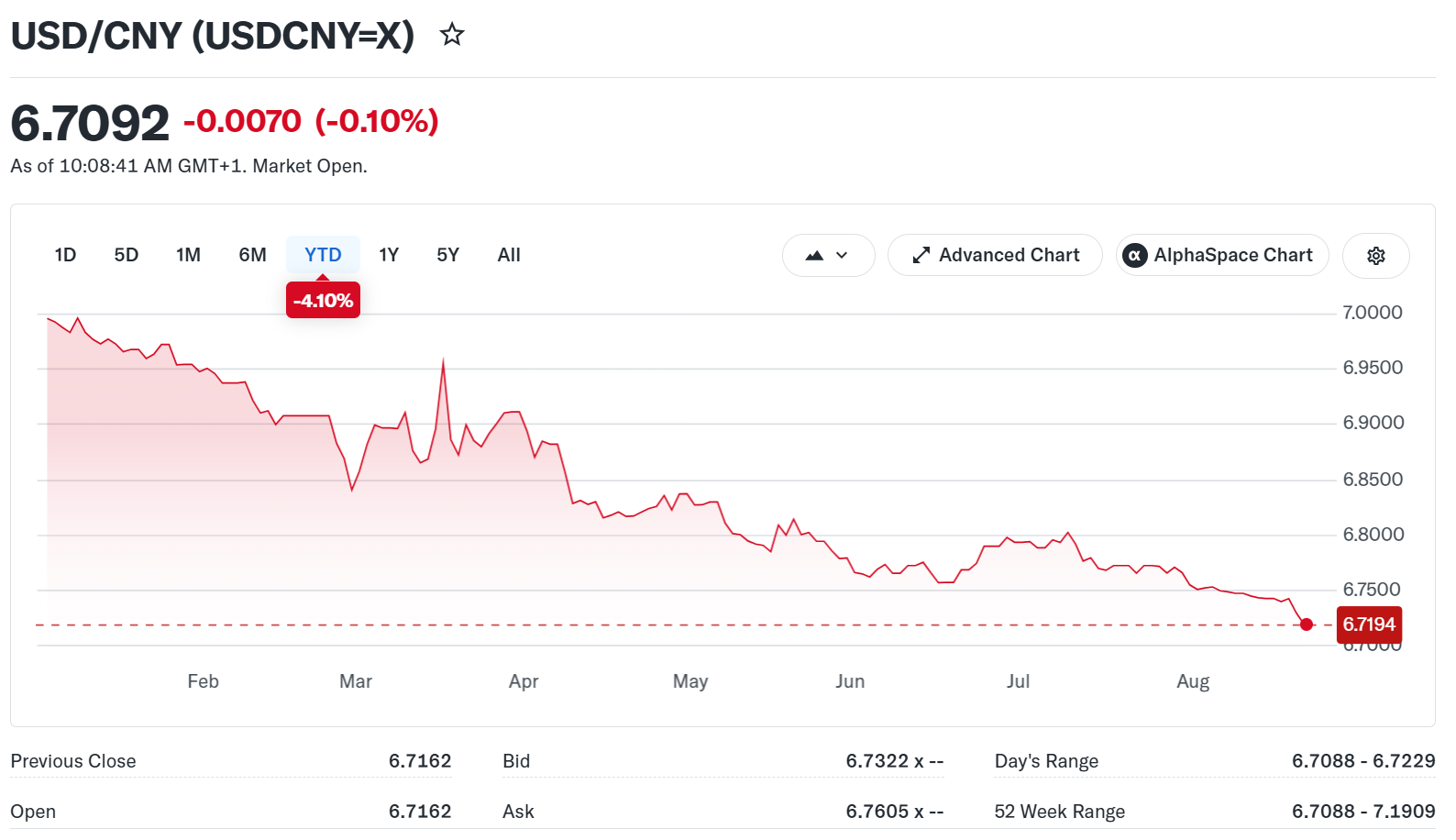
- PBoC Fix: 6.7817 vs exp. 6.7262 (prev. 6.7808)
- Shanghai Shenzhen CSI 300 rose 0.57% to 4,618.90
Sources: Investing.com, Bloomberg, Reuters, Yahoo Finance, US Census Bureau, Trading Economics, Tradingview