By Michael O’Neill
It is becoming increasingly difficult to make the case that the Canadian dollar should be weaker simply because Canada is having a trade war with the United States. If anything, the latest developments suggest the opposite.
Ottawa is retaliating against Washington’s latest round of tariffs with countertariffs on roughly $27.6 billion of US goods. The list includes steel and aluminum, machinery, paper, electrical equipment, seafood, furniture and a remarkably eclectic collection of consumer products. The tariffs are scheduled to take effect September 8, with most set at 25% or 50%.
That sounds like another negative for Canada. It isn’t necessarily.
For one thing, Canada’s response is targeted rather than indiscriminate. Ottawa is attempting to protect domestic producers while putting political pressure on US states and industries that have something to lose from the trade war. Ohio, Illinois, Pennsylvania, California and Michigan are among the states facing the largest dollar impact.
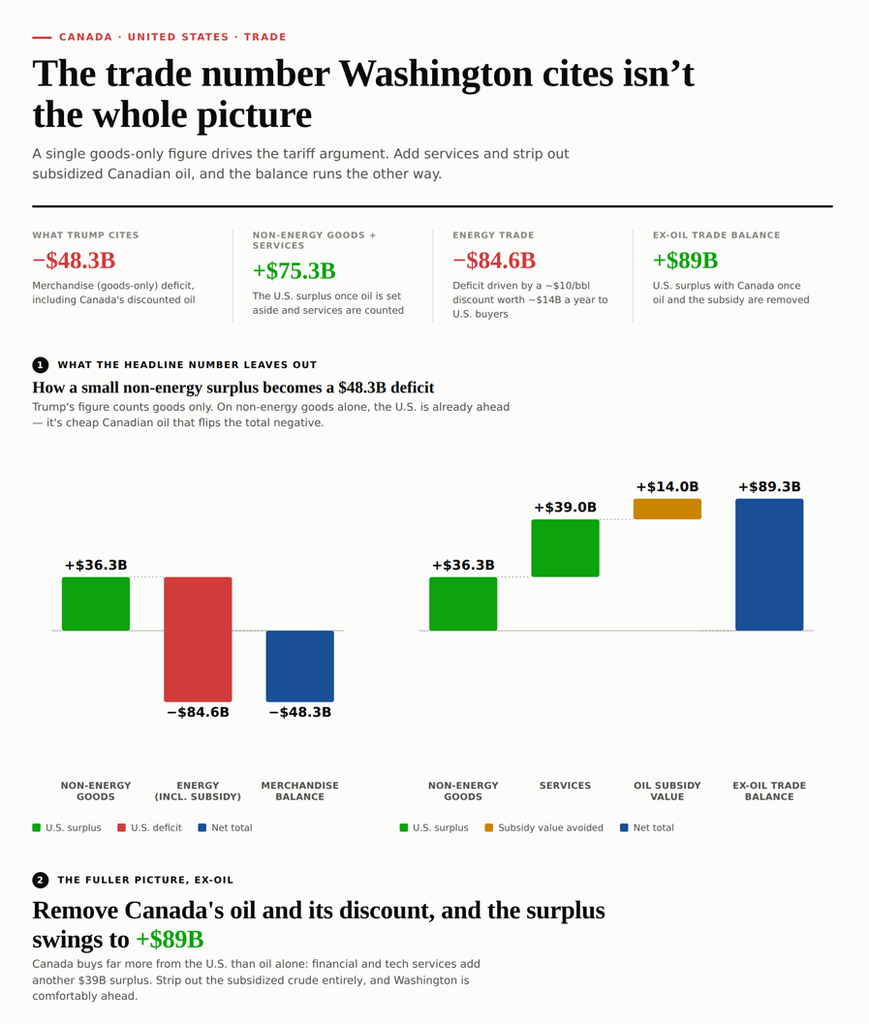
More importantly for FX markets, the latest round of tariff theatrics is drawing attention to something that has been hiding in plain sight: the arithmetic of Canada-US trade does not look nearly as bad for Canada as the headline numbers suggest.
Trump says the United States has been getting ripped off and claims the bilateral deficit is around US$60 billion. The actual 2025 goods deficit was US$48.3 billion.
It’s America Ripping Off Canada
Trump has never been shy about accusing Canada of ripping off or cheating the United States. Since his 2025 inauguration, he has repeatedly made the claim, often dressing it up with ever-larger numbers and increasingly colourful accusations.
Today he once again vented on TruthSocial: “Canada has been ‘Ripping Off’ the U.S.A. for decades. They have been charging our Farmers 400% Tariffs, and more. They have driven many wonderful U.S. companies out of business. For 10 years they wouldn’t certify Gulfstream Jets, until I got involved. They wanted 100% of the market for Gulfstream’s Canadian competitor. I deal with many countries, and Canada is easily the most difficult and unreasonable. They feel entitled, but they are not a State and will be entitled no longer! President DJT”
As is often the case, Trump’s version and reality are not even close.
Trump’s latest tweet saying he would slap another 50% tariff on Canadian cars and trucks beginning January 1, 2027 is really an invitation for both sides to keep talking.
Nevertheless, the uncertainty around what is shaping up to be a full-blown Canada-US trade war is certainly impacting USDCAD, however not to the extent implied by the rally from 1.3740 last Friday to 1.3893 today. The bigger catalyst is rising odds for a Fed rate hike on September 16.
See You in September
The greenback rallied across the board after the US released a slate of top-tier economic reports, including the Powell Fed’s favourite inflation measure, core PCE price index. Don’t read too much into the move.
The latest US data may be modestly hawkish on inflation, but hardly enough to change the Fed’s September outlook. Core PCE rose 0.2% m/m and remained stuck at 3.3% y/y, while headline PCE accelerated to 3.7%. That is hardly the progress the Fed wants to see, but neither is it an inflationary blowout.
The rest of the report was decidedly less hawkish. Q2 GDP was unrevised at 1.5%, while July personal spending rose just 0.2% and real spending was flat. Personal income increased 0.4%, allowing the savings rate to rise to 3.0%. In other words, consumers earned more but largely chose to save it rather than spend it.
So what does this mean for the Fed? Not much. The numbers reinforce the argument for patience rather than provide a compelling reason to hike in September. The dollar’s reaction is more a factor of very thin, end-of-summer markets.
The next numbers that matter for this pair are not tariffs. They are the ones coming from the September 16 FOMC meeting.