By Michael O’Neill
Final Fantasy is a fantastically successful video game and movie franchise that has generated more than $20 billion since the first game was released in 1987. It thrives on epic quests, mythical enemies, and the comforting notion that persistence, teamwork, and a few magical crystals can save the world.
The International Monetary Fund has now released its own version of Final Fantasy, titled “Canada Can Grow Faster by Unlocking Its Own Market.” (Not exactly a catchy title).
The video game is fiction, but the IMF’s version is reality. Unfortunately, it shares one important similarity with the franchise: it assumes that if the obstacles are clearly identified, someone will eventually step forward and defeat them. In the real world that “someone” never shows up.
The IMF makes a compelling economic case for removing interprovincial trade barriers in Canada, arguing they represent a self-inflicted wound that continues to drag on growth. Barriers in finance, transportation, telecommunications, professional licensing, and procurement quietly tax nearly every business activity in the country. The result is less competition, reduced scale, weaker productivity, and poorer labour mobility.
In some sectors, the implied trade barriers exceed 40 percent, levels that would be unthinkable in any international trade agreement Canada has signed. Canada has spent decades negotiating away barriers with foreign governments, while leaving far larger ones intact at home.
The Benefits are Obvious
According to the IMF, eliminating non-geographic internal trade barriers could lift real GDP by close to 7 percent over time, roughly C$210 billion in today’s dollars. These gains would come from productivity, better capital allocation, stronger competition, and firms would finally be able to operate at national scale. Services matter most, accounting for most of the gains, because they are embedded in nearly every supply chain.
If that happened, Canada would suddenly vault to the top of the G-20 growth table. The Canadian dollar would almost certainly respond, and it is not much of a stretch to see the Loonie flirting with 90 cents against the U.S. dollar.
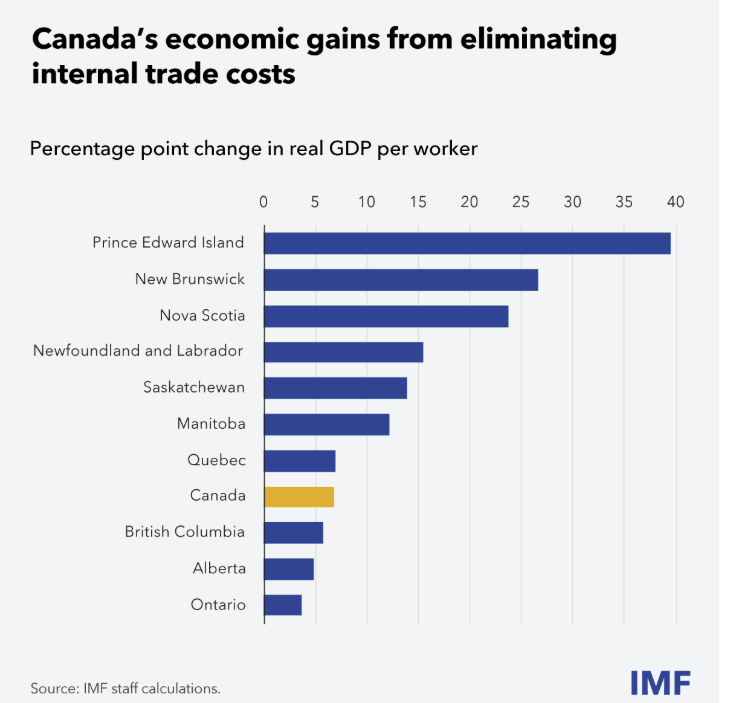
Turf Wars
The IMF can model away internal trade barriers. It cannot model away Canadian politics. The economics are not wrong. They are simply irrelevant to the decision-makers.
At the core of the problem is federalism. Provinces guard jurisdiction the way Norway guards its “Doomsday Vault,” and for good reason. Once power is ceded it rarely returns. Internal trade barriers are the by-product of deliberate political choices that allow provinces to control labour markets, regulate professions, favour local suppliers, and shape economic outcomes to local priorities.
In Quebec, regulatory autonomy is not merely an economic preference. It is a political identity.
Then there is Alberta, where the frustration runs in the opposite direction. Alberta’s economy remains tethered to energy, yet it faces regulatory headwinds from provinces happy to consume Federal transfer benefits while blocking the infrastructure that funds it.
Provinces do not view internal trade liberalization as a shared national project. They view it as a negotiation over who loses leverage.
Canada and the New World Order
The world order is currently undergoing a massive upheaval orchestrated by Trump. This shift is rapidly transforming a rules-based multilateral system into a purely transactional one driven by leverage. The United States of America was once a beacon of hope, a defender of the downtrodden, and a champion of democracy. Today, it has become the catalyst for chaos.
For Canada, what began in 2025 as tariff brinkmanship by the US has hardened into a confrontation.
New tariffs land like snow in January (or rain in Vancouver). On January 29, Trump used his TruthSocial soapbox to whine that “Canada has wrongfully, illegally and steadfastly refused to certify the Gulfstream 500, 600, 700 and 800 jets,” then said, “Further, Canada is effectively prohibiting the sale of Gulfstream products in Canada through this very same certification process.” That complaint came with the threat of a 50% tariff.
As usual, the claim is baseless.
American diplomacy is now deliberately abrasive. Trump was annoyed that Mark Carney didn’t cower before him and was embarrassed about how Carney upstaged him at the Davos Economic Forum. Carney got a standing ovation while Trump was mocked.
That led to Trump threatening a 100% tariff if Canada signed a trade agreement with China, even though a week earlier Trump said that dealing with China was the smart thing to do.
Many still hope that the current US trade hostility toward Canada is just posturing prior to the next round of Canada-US-Mexico-Agreement on trade negotiations.
If not, the elimination of interprovincial trade barriers may need to become a reality and not an IMF Fantasy game.