March 4, 2026
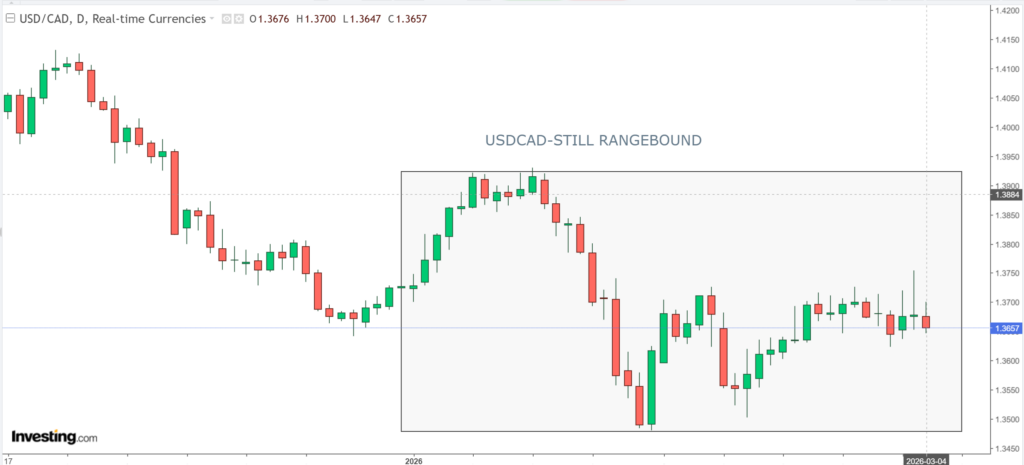
USDCAD open: 1.3671, overnight range 1.3644-1.3700, close 1.3679
The Canadian dollar squeezed out some gains overnight, with the loonie still getting support from higher oil prices. Geography is another factor supporting the Canadian dollar, as Iran doesn’t have a missile that can hit Canada.
Prime Minister Mark Carney is continuing his trade diversification mission in Asia and is currently in Australia. Carney is discussing building a critical minerals alliance and “smoothing the way for government investments in projects of mutual interest,” according to The Globe and Mail.
WTI oil prices peaked at 77.22 in Europe before dropping to 734 in early New York trading then climbing back to 74.02. President Trump’s comments about escorting oil tankers through the Strait of Hormuz, while providing a form of insurance, have helped cap increases so far. However, Iran’s Revolutionary Guard has declared the Strait closed and “open season” on any ships transiting it.
Bank of Canada Governor Tiff Macklem is speaking at 7:30 am PT today at a Global Risk Institute event regarding financial stability risks and vulnerabilities.
USDCAD Technical Outlook
The intraday USDCAD technicals are slightly bearish while trading below 1.3680. A break above 1.3730 extend gains toward 1.3760 and then 1.3800. A move below 1.3640 targets 1.3610 and then 1.3585.
The medium-term technicals are bearish while trading below the 1.3800–1.3840 zone, which contains the 200-day and 100-day moving averages. That suggests recent gains are corrective within a broader consolidation phase. The 1.3500–1.3800 band remains intact with a break below 1.3585 putting 1.3500 in play, while a sustained move above 1.3840 would argue for a shift toward 1.3920.
For today, USDCAD support is at 1.3640 and 1.3610. Resistance is at 1.3730 and 1.3760.
The Donald J Trump War-Day 5
Risk aversion sentiment continues to ripple across global financial markets. Tanking US stock markets and soaring domestic gasoline and other fuel costs prompted Trump to say he would order the US International Development Finance Corp. to provide political risk insurance and financial guarantees to ships transiting the Strait of Hormuz. He is also talking about having US Navy ships provide an escort service.
In the US, the US Senate is voting on a bipartisan war powers resolution in hopes of stopping Trump’s military campaign in Iran. Even if it passes, it is a long way from becoming law.
US ADP Jobs Data on Tap
US ADP reported that 63,000 jobs were added in February compared to the forecast of 50,000 and 22,000 in January. In addition, ISM Services PMI, the ISM Employment Index, and ISM Prices Paid numbers are due.
Taking Stock
Asian equity markets extended yesterday’s losses. Japan’s Topix plunged 3.67%, Hong Kong’s Hang Seng fell 2.201%, and Australia’s ASX dropped 1.94%.
As of 7:10 am, European bourses have turned positive. The German DAX has gained 1.46%, the French CAC 40 is up 1.00%, and the UK FTSE 100 has risen 0.66%. The DXY traded in a 98.70-99.24 range and is 98.77. The 10-year Treasury yield is 4.079%, and gold (XAUUSD) is 5,195.79.
EURUSD
EURUSD traded in a 1.1574-1.1655 band and is at 1.1641 in NY. Trump’s war in Iran and the subsequent closure of the Strait of Hormuz has raised risk aversion and US dollars were the safe haven of choice. Sentiment was not helped when Trump threatened to cease all trade with Spain because that country would not let the Americans use its military bases to wage war on Iran. Eurozone Composite PMI was 51.9, as expected, while German Composite PMI was 53.2 compared to the forecast of 53.1.
GBPUSD
GBPUSD clawed back some losses in a 1.3304-1.3403 range and is trading in NY at 1.3377. UK Composite PMI was 53.7 (forecast 53.9), but it had little impact. S&P wrote: “Business activity continued to pick up across the UK service economy in February, with growth holding close to the five-month high seen at the start of 2026.” GBPUSD downside is underpinned by speculation that uncertainty around the economic fallout from Trump’s war will force the BoE to leave rates unchanged at its March 19 meeting.
USDJPY
USDJPY eased lower in a 156.86-157.86 range, with topside gains limited due to fears of BoJ intervention, while the downside is underpinned by broad US dollar demand. In addition, higher oil prices risk derailing Japanese economic growth.
AUDUSD
AUDUSD bounced in a 0.6985-0.7045 range, with the lows stemming from risk-aversion US dollar demand offset, to a degree, by better-than-expected economic growth. Q4 GDP rose 0.8% q/q (forecast 0.6%, previously and upwardly revised from 0.5%) and 2.6% y/y (forecast 2.2%). AUDUSD is also supported by the Australian Industry Index, which was lifted by 9.0 points to near neutral in February, the strongest headline result in four years. The uplift was driven by significant gains in the employment, input, and new orders indicators, while activity and sales remained flat.
USDMXN
USDMXN is trading defensively in a 17.5339-17.7738 range due to ongoing risk aversion sentiment underpinning the US dollar alongside weak domestic fundamentals.
China
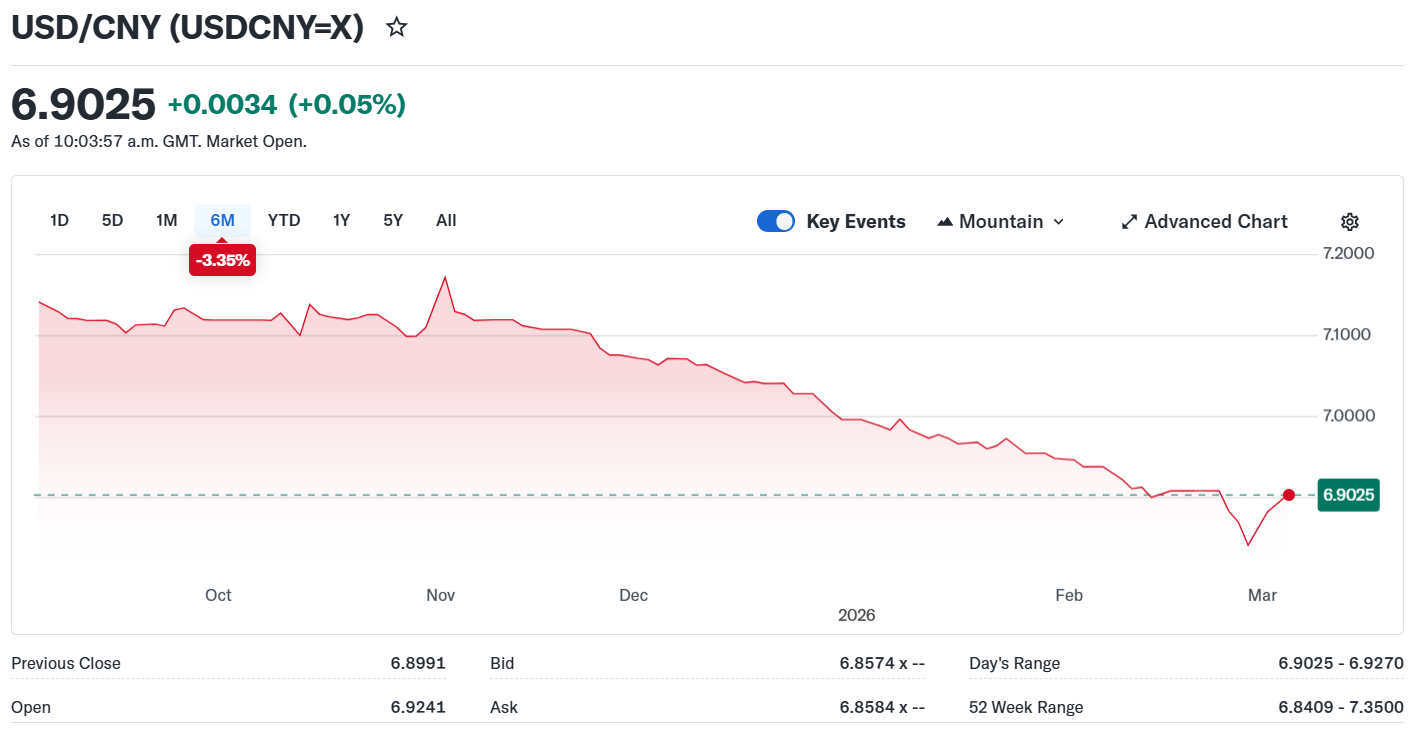
USDCNY Fix: USD/CNY mid-point at 6.9124 (Prev. 6.9088)
Shanghai Shenzhen CSI 300 fell 1.14% to 4,602.63
RatingDog PMI rose to 52.1 in February, from 50.3 in January, indicating the sharpest overall expansion since December 2020. RatingDog Founder Yao Yu said ““Overall, February’s data show a strong expansion driven by robust supply and demand, with a notable external demand rebound.”
China’s official PMI was 49 in February (49.3 in January) while Non-Manufacturing was 49.4 (previous 49.3)
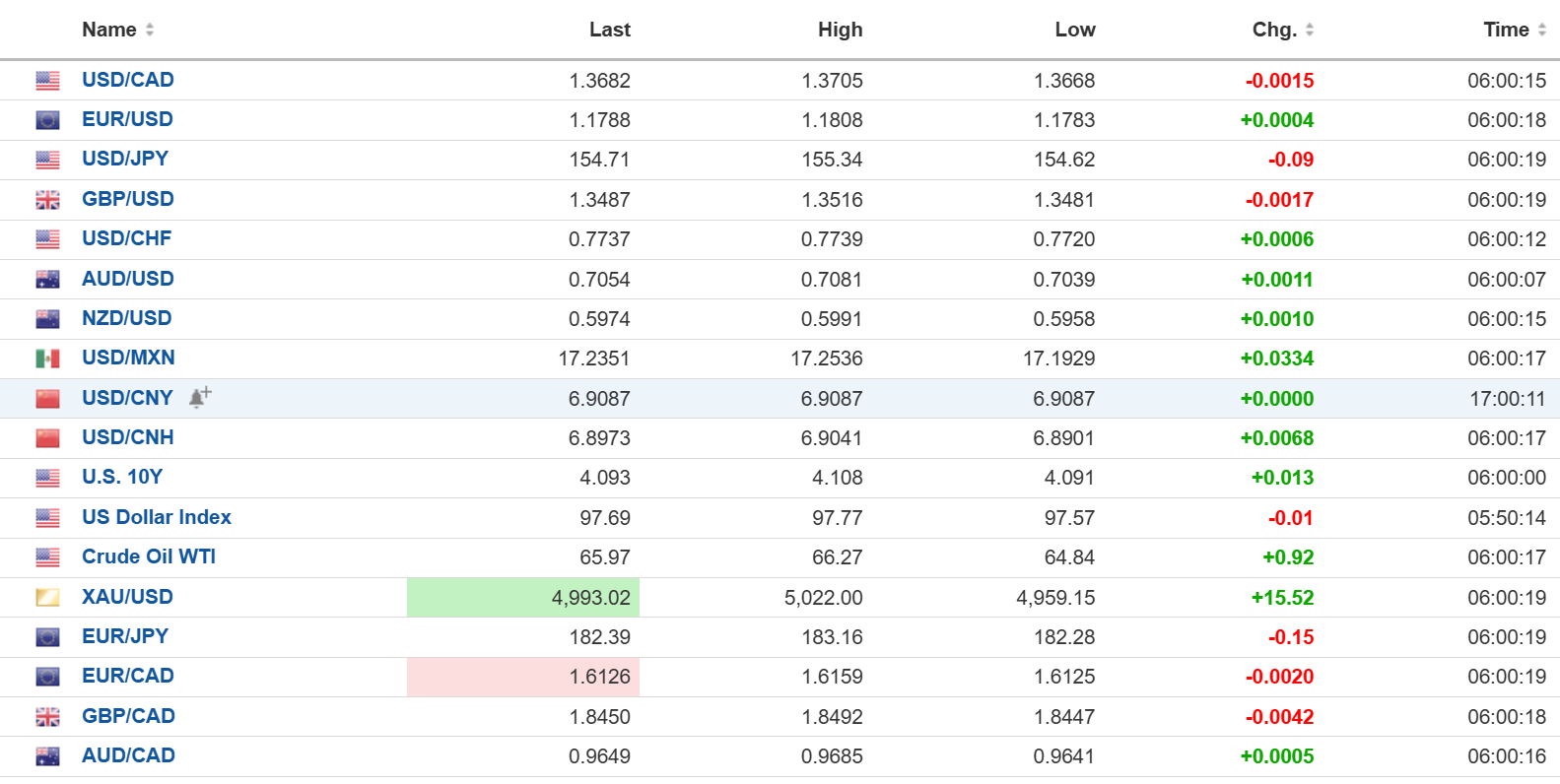
FX open high low
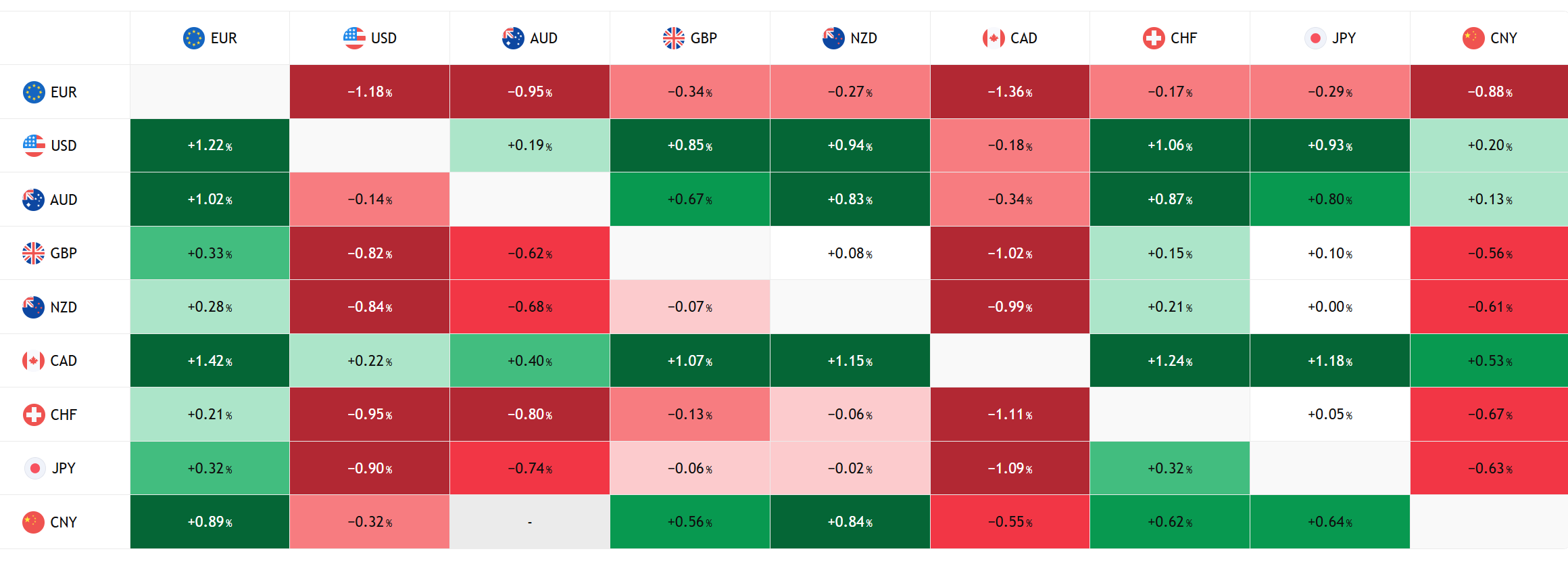
FX Heat Map (6:00 am) one week
Sources: Investing.com, Bloomberg, Reuters, Yahoo Finance, US Census Bureau, Trading Economics Tradingview