By Michael O’Neill
Oil has been soothing mankind for centuries, whether rubbed into dry skin, worked into a sore muscle or used to keep the machinery of everyday life running smoothly. It calms, lubricates and takes the friction out of things.
Who knew that crude oil was infused with the same attributes? Perhaps Canada can turn its vast oil resources into an economic balm.
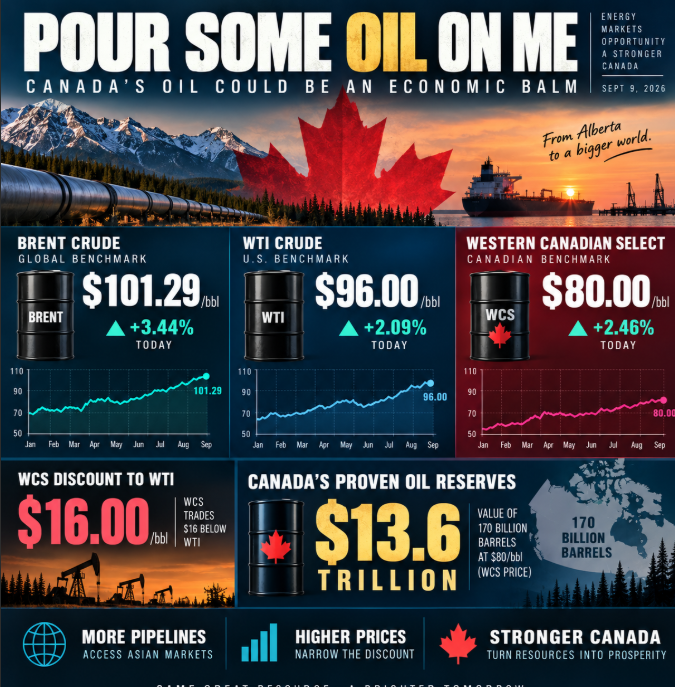
Canada is blessed with around 170 billion barrels of proven oil reserves which, if monetized, would go a very long way in soothing the aches and pains from the Trump administration’s aggressive anti-Canada trade agenda.
“The numbers don’t lie. The current price of Western Canada Select (WCS), Alberta’s heavy crude grade exported to the U.S., is around $80.00/barrel compared to the benchmark West Texas Intermediate (WTI) at $96.00/b. That’s a $16/b discount enjoyed by American’s at Canada’s expense.
Long-Term Gain
But the U.S. has turned hostile and Trump claims America doesn’t need anything from Canada, including oil. That may be true. Trump has essentially annexed (stolen) Venezuela’s roughly 300 billion/b of oil reserves giving U.S. refiners another potential source of heavy crude that competes with Canadian oil.
The U.S. may not need Canadian resources, but other countries do, particularly in Asia. By fast-tracking pipeline capacity to the Pacific coast, Canada could redirect a massive volume of crude from the captive U.S. market to serve China, Japan and South Korea, to name a few.
The potential prize is enormous. ICE Brent is the global benchmark for seaborne oil and is currently about US$100/b. Canadian crude selling into Asia is at a US$6/b discount to ICE Brent. Canada is getting US$94/b, or US$14.00 more than the current price the US pays for WCS.
Furthermore, Canada exports around 1.6 billion barrels every year, and the additional $14/b from selling into Asia represents a potential windfall of around $22.4 billion.”
Short-Term Pain
Oil may prove to be a panacea for some of Canada’s economic woes, but not in the short term. Trump’s economic war on Canada is going to leave a mark.
The latest salvo came Sunday, when Trump declared that Canada’s “currency” dollar imbalance with the United States was “unacceptable” and had been that way for years, “but no longer!” He offered no explanation of what he considers an imbalance or what he intends to do about it.
Failing Economics for Dummies
Trump was described by the late William T. Kelly, a marketing professor at Wharton, as the “dumbest goddam student I ever had.” His Canada “currency dollar” quote certainly does little to challenge the professor’s assessment.
FX traders couldn’t believe how imbecilic Trump’s words were because they understand that the Canadian dollar is not priced by presidential decree. There are a whole mess of variables that go into determining the Loonie’s, or any other free-floating currency’s, value.
Trump cannot simply dictate where the currency trades unless he can simultaneously set global interest rates, oil and other commodity prices, while setting the level of growth by country. He can, however, influence risk appetite, capital flows and fiscal policy through his words and deeds, although markets are regularly discounting everything he says.
The Times They Are A-Changin’
Canada’s dependence on the U.S. has long been a fundamental weakness for the loonie. The United States takes the overwhelming majority of Canada’s crude exports, leaving Canadian producers exposed to the discounts created by limited access to alternative markets. Trump has forced Canada to look for economic prosperity elsewhere.
Even better, Trump’s erratic behaviour and hostility toward other G20 countries could make diversification increasingly valuable.
The Trans Mountain expansion has already opened the Pacific coast to substantially greater exports, and Canadian crude exports to non-U.S. markets have surged. The success of that venture is driving projects and discussions for other outlets, including the Northern Shield Energy Corridor from Alberta to Ontario. The proposed corridor would run approximately 3,300 kilometres from Hardisty Alberta to Sarnia Ontario and could initially transport 500,000 barrels a day, with potential expansion to 800,000 barrels a day.
Politicians are also discussing other potential northern export gateways, including the feasibility of developing deep-sea access to Hudson Bay. It is not just an energy story. It is a potential structural improvement in Canada’s external accounts, and therefore a potential source of support for the loonie.
But not today.
The Song Remains the Same
The value of the Canadian dollar continues to be driven by a varied mix of influences including, but not limited to, U.S. and Canada interest rate differentials, commodity prices, risk sentiment around the Iran-U.S. conflict, Fed independence and rising U.S. government debt. Friday’s U.S. inflation number, followed by the market reaction to next week’s FOMC meeting, will determine USDCAD direction. Meanwhile, long-term technical indicators suggest that the 1.3650-1.3950 range will remain intact.
Canada’s answer to Trump is to turn its oil into an economic balm.