By Michael O’Neill
It’s tough being the Governor of the Bank of Canada. He is charged with promoting price stability for the country by keeping inflation in a low and stable 1-3% target range. It’s even tougher when domestic interest rate decisions are being determined by bond traders and the Fed.
The Bank of Canada didn’t surprise anyone with today’s decision to leave its overnight rate at 2.25% on Wednesday. Governor Tiff Macklem supported the decision by saying the Canadian economy has strengthened, with second-quarter GDP rising 3.3%, consumption remaining resilient, housing activity rebounding and exports and business investment picking up sharply. The labour market has also improved, although excess supply remains.
The problem is that the rationale is already stale. New U.S. tariffs and the continuing uncertainty over Canada-U.S. trade raise the risk of a sharp economic slowdown. At the same time, inflation has become more uncomfortable. CPI is running around 3%, although Macklem stressed that this is largely due to higher gasoline prices. He failed to stress that the Bank’s preferred inflation metrics, CPI-trim and CPI-median are bang on the mid-range inflation target.
The Middle East conflict and curtailed oil shipments through the Strait of Hormuz have pushed energy prices higher and increased the risk that temporary inflation becomes persistent.
The loonie initially liked what it heard. USD/CAD dropped from around 1.3880 to 1.3840 as traders increased their bets that the BoC may have to raise rates if inflation refuses to cooperate. And that is precisely where the Bank runs into its problem. It can control the overnight rate, but it cannot control the cost of longer-term money. For now, it increasingly belongs to the bond market.
Over to You, Bondo’s
Global bond traders couldn’t care less about today’s Bank of Canada deliberations. That is simply because Canada’s gross government debt of around $3.3 trillion pales in the face of the gargantuan $40 trillion in American borrowings. Sure, on a debt-to-GDP basis Canada’s 111% isn’t even close to prudent fiscal management, but the U.S. is worse. Its debt is around 126% of GDP. Because of its position as the worlds benchmark borrowing asset, bond traders have taken notice.
The resurgence of Trump’s war with Iran in mid-July was the initial catalyst for the bond-market selloff. Rising oil prices reignited inflation fears, forcing traders to rethink expectations for Fed rate cuts and increasing the possibility of higher rates. Treasury yields rose, and because U.S. Treasuries anchor global borrowing costs, the selloff quickly spread to European and Japanese bonds.
What began as an oil shock has since become a much bigger problem. Large government deficits, heavy debt issuance and aggressive corporate borrowing for the AI boom are keeping pressure on bond yields. The Iran conflict may have reignited inflation fears, but the bond market was already becoming increasingly uncomfortable with the amount of debt it is being asked to finance.
Follow My Lead
Treasury Secretary Scott Bessent dismissed the surge in Treasury yields saying “what happens over a month doesn’t matter.” He presided over the August 31-September 1 G20 Finance Ministers meeting in North Carolina and arrogantly said “With America once again leading this forum, the days of settling for subpar growth are over.” The problem with that is that it is a made-in-America problem. Trump’s tariffs, massive deficits, ballooning debt and policy uncertainty are hardly foreign forces conspiring against the U.S. economy.
If American’s are leading anything, it is American bond traders. They are leading the drive for higher yields. Since the resumption of Iran-U.S. hostilities in mid-July, the 10-year Treasury yield has risen from 4.36% to 4.82% today.
Central banks can set overnight rates, treasury officials can talk about growth but ultimately, somebody has to buy the bonds. Today investors are demanding more compensation for inflation, fiscal deterioration and geopolitical risk and their demand is reflected in the prevailing yields.
Sidewalk Soufflé
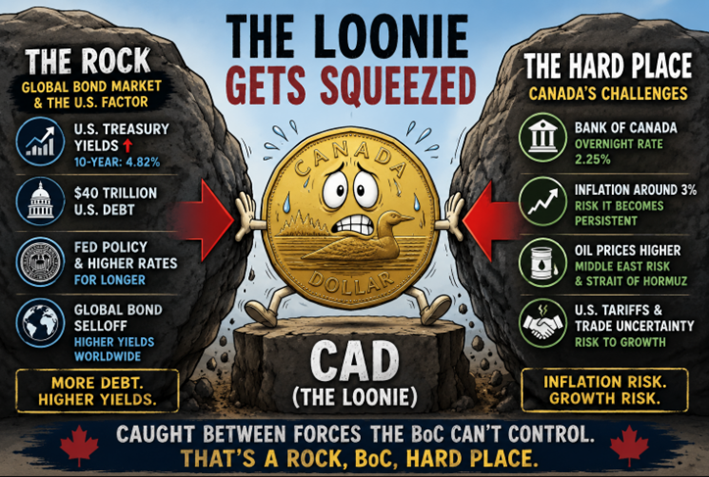
The Loonie is caught between two powerful forces.
Oil and an improving Canadian economy argue for a stronger loonie. The United States is trying to grow its way out of $40 trillion of debt while simultaneously wanting lower borrowing costs.
The Fed is trying to contain inflation while facing pressure for lower rates. Oil is adding another inflationary complication. And investors around the world are demanding greater compensation for holding government debt. Global bond yields are now at multi-year highs as the selloff spreads from Japan and Europe to the United States and Canada.
That makes September particularly interesting. The loonie doesn’t necessarily need the BoC to become hawkish. It needs the global bond market to stop making the U.S. dollar more attractive. When the rock and the hard place meet, the loonie is likely to go “splat.”