By Michael O’Neill
USDCAD traders who spent the past month looking for direction from crude oil have been looking at the wrong screen. WTI is trading around $95 a barrel, roughly 45% above its pre-war level, and the loonie is sitting near 1.4300 cents. If oil still called the tune, the Canadian dollar would be the belle of the ball. Instead, it can’t get a dance.
The real driver is the gap between Canadian and US interest rates, and Wednesday’s US inflation report just made that gap wider.
A Hot Print with Legs
US consumer prices rose 3.7% y/y in September, up from 3.4% in August and slightly above the 3.6% forecast. With gasoline and fuel oil soaring over the year, the energy shock was hardly a surprise. The real worry was core inflation, which refused to cool as expected. Price pressures were broadening, with shelter, used cars and apparel adding to the bill. Airfares have surged, while computer prices recorded their biggest annual increase since records began in 2006. The message for the Fed is as uncomfortable as it is obvious: this is no longer just an energy story.
Traders responded by nearly tripling the odds of an October Fed hike to roughly 60% from 22% before the report, and two quarter-point hikes are now fully priced by January. The US two-year Treasury yield climbed 10 basis points to 4.88%, and USDCAD traders took notice.
Betting the Spread
Football fans who like an occasional flutter on the outcome of a game are very familiar with betting the spread. Bond traders like betting the spread, and billions of dollars change hands when yield differentials widen or narrow.
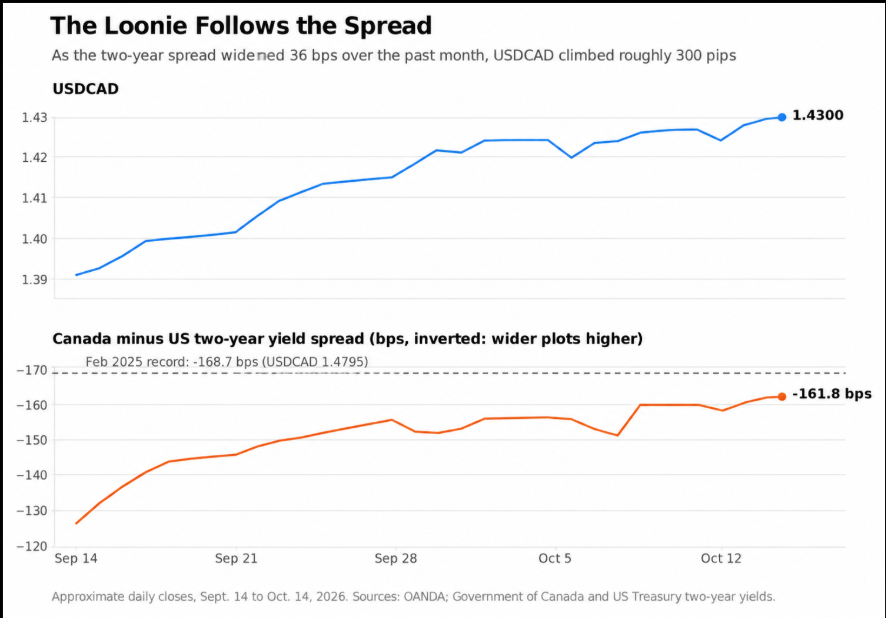
The Canada-US two-year yield spread has widened to -161.8 basis points, 35.7 bps worse than a month ago. That is within shouting distance of the record low of -168.7 bps set on February 3, 2025, the week Trump signed his first tariff order and USDCAD peaked at 1.4795.
Yield spreads and the loonie are marching in lockstep. Since mid-September, the Canada-US two-year yield gap has widened from roughly -126 bps to -162 bps, while USDCAD has climbed from 1.3760 to 1.4300. The relationship is remarkably tight, with each additional basis point of spread corresponding to roughly 15 pips of USDCAD upside.
The widening yield gap has become the primary driver of USDCAD, with capital favouring higher-yielding US assets over their Canadian counterparts. The IMF’s latest outlook helps explain why the gap is unlikely to close anytime soon.
Good News, Bad Loonie
The IMF’s latest World Economic Outlook forecasts Canadian growth picking up to 1.7% in 2027 from 1.1% this year, with inflation easing to 2.4% from 2.8%. Faster growth and slower inflation should be the buffer the economy needs against hostile US trade policy, but that assumes it doesn’t get worse. And Trump’s comments made two weeks ago suggest that it will. He said, “Canada has been one of the worst countries in the entire world,” and Treasury Secretary Bessent echoed the remarks, saying that Canada was “more hostile to us than China.”
That doesn’t sound like an endorsement for Canadian economic growth to rise next year. The IMF’s projection that unemployment will ease to 6.3% next year also looks optimistic, given that the jobless rate is heading the wrong way.
The IMF sees US inflation at 3.6% this year and 2.8% in 2027, which is far higher than what it predicts for Canada. That gives the Bank of Canada every reason to sit on its hands while the Fed tightens. Good news for Canadian households is bad news for the loonie, and that may put its 2025 Trump-tariff peak in play.
The USDCAD 1.4795 Question
USDCAD reacted to the US inflation drama but remains locked into its over-two-week, 1.4200-1.4300 range. It failed to take advantage of multiple opportunities to blow through the bottom of the range but also rejected attempts for a topside breakout.
Something has to give. With US inflation proving stubborn, Canadian employment deteriorating and trade relations offering little comfort, the topside looks most vulnerable.
The straw that breaks the loonie’s back may be further widening of the two-year spread. If that happens, the tariff-shock peak of 1.4795 is a handy target.
Trump and bonds are the bane of the loonie.