By Michael O’Neill
World leaders have flocked to Turkey for COP31, the thirty-first UN Climate Change Conference. This one is different. Turkey is hosting the conference, but Australia is chairing the negotiations. That is how a year-long diplomatic dispute over hosting rights was resolved. If a simple issue about where to hold a meeting is that difficult, it doesn’t bode well for finding a solution to climate change.
The meetings are a forum on how to turn the world green. Global financial markets have adopted a similar tack, but instead of green energy, it’s greenbacks. And they are buying a lot of them.
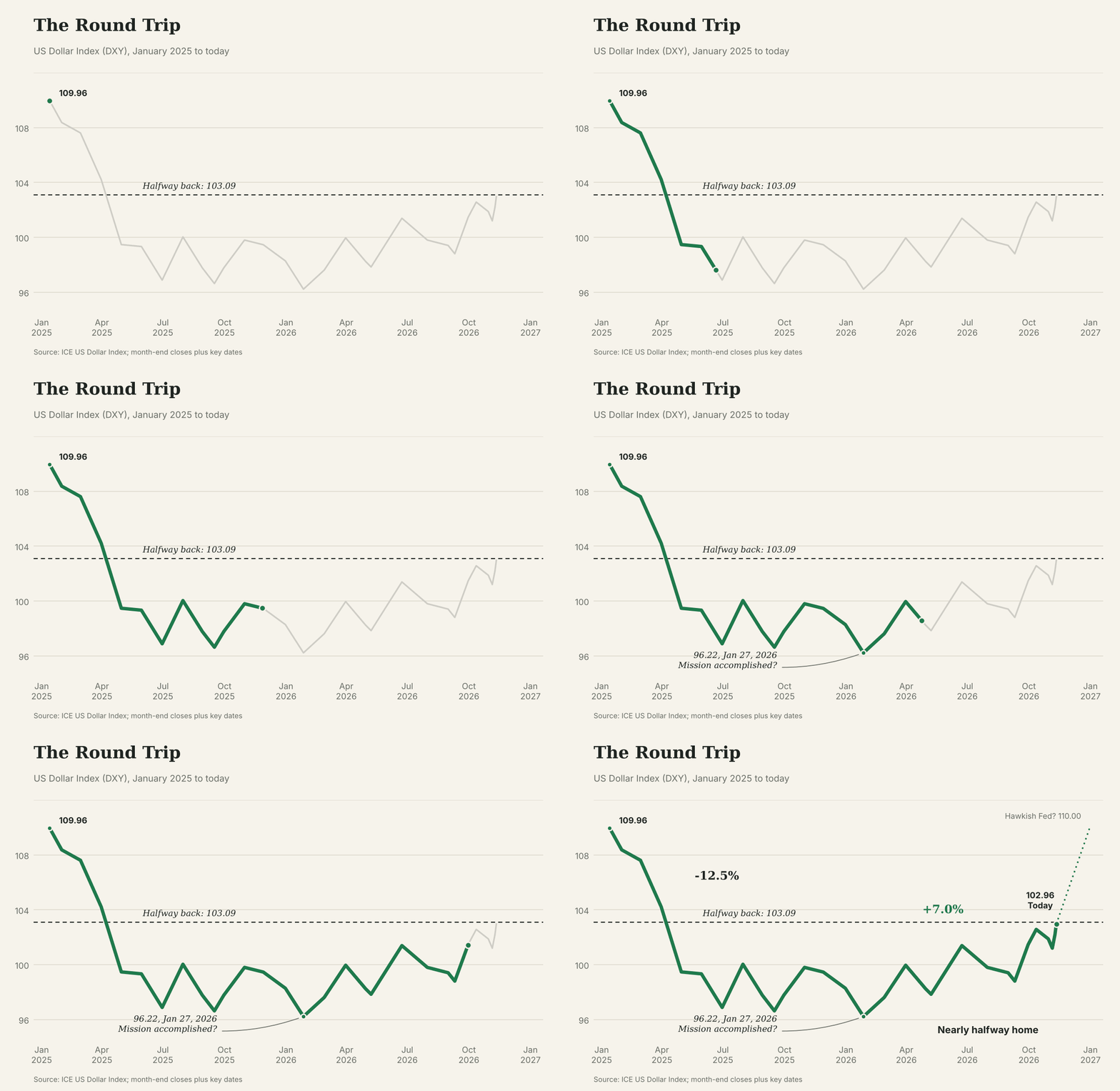
Since September 10, the US Dollar Index has climbed from around 98.8 to 102.96, a gain of approximately 4%. Oddly enough, the story starts with Trump’s return to the Oval Office in January 2025 and a White House that wanted a weaker dollar.
Do you remember the rumours about a Mar-a-Lago accord, which were circulating after Trump’s inauguration in January 2025? The proposal was a blueprint for a coordinated international plan using trade leverage, currency interventions, and reserve reallocations to systematically devalue the US dollar and rebalance global trade. It was championed by Stephen Miran, then Chair of the Council of Economic Advisers, and later a Fed governor, but never formally adopted.
Even so, elements of the plan found their way into the Trump administration policies, particularly by deploying aggressive, unilateral tariffs on friend, foe and penguins. The objective was to devalue the US dollar to reduce the trade deficit.
It was a dismal failure despite looking successful in the first year.
Self-Inflicted Sabotage
The sweeping tariff announcements in April 2025 managed to lower the US trade deficit from $903.5 billion in 2024 to $901.5 billion. That is not a success by any stretch of the imagination, especially since the goods deficit (imports vs exports) rose to $1.24 trillion from $1.21 trillion in 2024.
The tariffs knocked the greenback for a loop and the US Dollar Index (DXY) tumbled from around 109.60 on inauguration day to a low of 96.50 in six months.
Trump got his weaker dollar, but it was really a vote of non-confidence in America’s economic leadership. That’s what policy uncertainty, fears of a trade war and concerns that America was becoming erratic will do. Investors weren’t exactly rushing to embrace the new economic order and ironically it ended with the US dollar’s resurgence starting in January 2026.
The Bust Went Boom
Apparently, Americans didn’t read the reams of economic analysis and reports warning that Trump’s tariffs would choke economic growth, squeeze business profit margins, freeze capital spending and trigger a recession. It didn’t happen.
Instead, consumers consumed, businesses busied, and AI turned capex on its head. The economy was over the moon, but this moon had a dark side.
The war in Iran sent crude prices soaring and added fresh momentum to an already persistent upward drift in inflation. Expectations of aggressive Federal Reserve rate cuts faded rapidly with every CPI and PCE release, which boosted Treasury yields, and the dollar’s yield advantage became increasingly attractive.
Meanwhile, competing economies were hardly setting the world on fire. The eurozone was struggling with anemic growth, Japan was wrestling with its monetary policy transition and Canada was dealing with its own economic and trade challenges. The dollar became appealing because of a lack of alternatives. That attraction is unlikely to fade soon after a flock of Fed officials delivered hawkish interest rate outlooks following Tuesday’s robust inflation data.
Green Rally by Default
The year is nearly over and the DXY has recovered almost 50% of this year’s losses. Whether it gets back 100% will be determined by the Fed. The FOMC meeting is December 9, and despite Governor Christopher Waller warning that he would vote for a 50bp rate hike at the December meeting if core CPI remained unchanged (which it did), and his views being supported by Philadelphia and Chicago Fed presidents Anna Paulson and Austan Goolsbee, the odds for such a move are only 12%. If the expected 25bp hike occurs and it is followed by a hawkish statement, the DXY can easily hit 110.00. That would also weigh on the Canadian dollar.
Loonie may be the Christmas Goose
The Loonie is on the defensive. Any benefit from the October 28 Bank of Canada rate hike has faded under the weight of a weak jobs market, the prospect of lower oil prices if an Iran and US peace deal is negotiated and weak economic growth. The latest BoC Market Participants Survey showed 92% of respondents believe the economy is operating below capacity. Even so, Governor Macklem continues to hint that additional rate increases are likely. Raising rates in that environment is like a doctor amputating a person’s leg because of a respiratory issue.
Unfortunately, Tiff Macklem may be a closet MD wannabe.
.