By Michael O’Neill
The Canadian dollar is getting squeezed like a wild pig in the coils of a boa constrictor, and the pressure is approaching a tipping point
For months, the loonie has managed to absorb a steady barrage of negative headlines ranging from trade tensions and weakening domestic growth to widening Canada-US interest-rate spreads. But the combination of surging oil prices, rising US Treasury yields and the approaching July 1 CUSMA review deadline now threatens to push the currency into far more dangerous territory.
The problem for the loonie is that these pressures are no longer acting separately; they’re stacking up like an NFL dogpile, squeezing the currency while the US dollar gains ground. Chief among these compounding pressures is a fundamental breakdown in the loonie’s traditional relationship with the energy sector.
The Petrol Currency Paradox
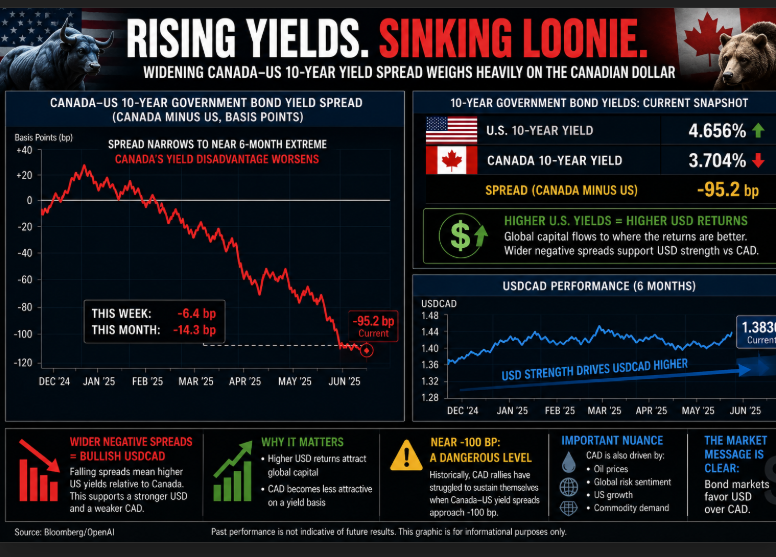
Historically, rising oil prices were viewed as supportive for the loonie because of Canada’s status as a major energy exporter. But this cycle is different. Today, oil’s inflationary impact on the United States matters far more than the direct trade benefits accruing to Canada. If rising energy prices force the Federal Reserve to maintain restrictive monetary policy while the Bank of Canada edges toward easing amid weakening domestic growth, the already severe Canada-US yield spread disadvantage could deteriorate even further.
Bond Traders Have Voted
Bond markets are already sending that warning. US two-year yields remain more than a full percentage point above equivalent Canadian rates while 10-year Treasury yields continue to trade near multi-month highs relative to Canadian bonds. Those widening spreads matter because currencies ultimately gravitate toward the jurisdictions offering superior returns. Right now, global capital is being rewarded for owning US dollars, not Canadian dollars.
That helps explain why the loonie has struggled to benefit from rising commodity prices. The market increasingly views Canada as trapped between weakening domestic fundamentals and an external inflation shock emanating from the United States. Every incremental rise in US yields tightens financial conditions for Canada while simultaneously undermining demand-sensitive sectors already struggling under trade uncertainty.
Trade Tensions Coming to a Boil
Meanwhile, as the July 1, 2026, CUSMA review deadline approaches, the broader macroeconomic conflict between Canada and the United States has transitioned from theoretical brinkmanship into a highly disruptive war of economic attrition.
The American negotiators, following Trump’s lead, view Canada with disdain. They have repeatedly ignored existing trade rules while using both legal and questionable tariff strategies to extract trade concessions.
The latest example emerged in agriculture after the US Department of Commerce imposed countervailing duties on fresh mushrooms grown in Canada. Washington effectively classified standard Canadian provincial tax exemptions available to farmers as unfair subsidies while conveniently ignoring similar structures operating inside the United States.
Algoma Steel’s latest results provided a brutal illustration of the pressure facing Canadian manufacturers. The company posted a quarterly loss exceeding $159 million as US Section 232 steel tariffs and collapsing export volumes hammered profitability. Shipments into the United States have plunged.
Americans are Feeling some Pain
Canadians are shunning travel to the United States and border states are feeling the pinch. Vehicle crossings are down roughly 35% from their 2024 baselines and air travel has fallen just as sharply. The U.S. Travel Association report details an estimated US$5.7 billion shortfall in international visitor spending triggered by the collapse in Canadian arrivals.
However, recent research from the University of Toronto’s School of Cities suggests that the economic damage runs far deeper than these official border statistics imply. Utilizing cellphone mobility tracking, researchers revealed a staggering 42% median decline in Canadian visits to major U.S. metropolitan areas, exposing a severe contraction that extends well beyond standard holiday tourism.
Ultimately, this deep integration decay is starving border-state retailers of revenue, hollowing out local tax bases, and leaving key regional markets to navigate traffic collapses of up to 27% directly tied to the sudden absence of Canadian professionals and consumers. The White House doesn’t care because the states taking the biggest hits are Democrat.
But Kentucky is a Republican State, and its bourbon producers are being spanked by Canada’s provincial liquor bans. What began as symbolic retaliation against US tariffs quickly turned into a devastating commercial hit, with American spirits exports to Canada collapsing by as much as 68% while wine exports cratered 78%, wiping out Washington’s long-standing wine trade surplus in the process.
So Now What
The reaction in Washington has been visceral. The White House no longer views the liquor bans as some minor retail dispute. Instead, it has elevated them into a major political grievance and is now trying to force their removal as the price of admission for restarting stalled CUSMA negotiations.
The convergence of these risks has driven the loonie to the tipping point where one misstep could send it plunging into the abyss.