October 13, 2026
USDCAD open (6:00 am): 1.4259, range since Friday, 1.4240-1.4289, close 1.4284
USDCAD climbed to 1.4301 on Friday, its highest level since April 2025, after Canada’s September employment report showed a loss of 68,300 jobs following August’s 41,700 decline, while unemployment rose to 6.5%.
Canadian two-year yields fell, widening the spread against US yields to around -161 basis points but the have narrowed to-158 bps today. The Fed is leaning hawkish and US tariffs continue to cloud Canada’s economic outlook.
WTI traded choppily in a $89.98-$93.48 band and largely dismissed Trump announcement of an energy ceasefire between Russia and Ukraine. Ukraine is free to bomb apartment buildings and day care centers in Moscow and elsewhere, but the country will face the wrath of Trump if it attacks oil infrastructure. He wants Russian diesel fuel.
Meanwhile, Yemeni Houthi’s renewed attacks on Riyadh, prompting Saudi airstrikes, Iran continues to hold the Strait of Hormuz hostage to its seven conditions, with another tanker reportedly striking a mine.
US September existing home sales is the only data of note today.
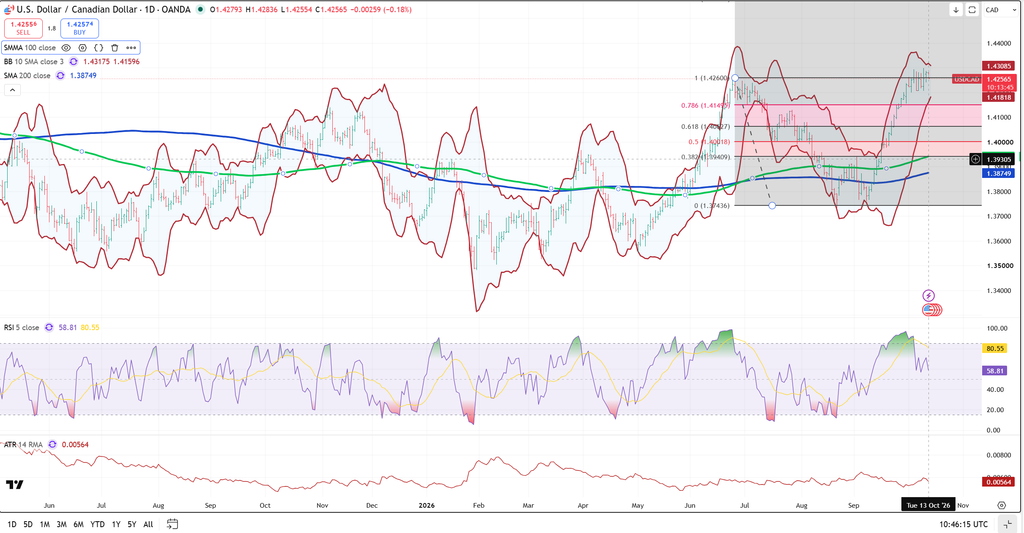
USDCAD Technical Outlook
The intraday USDCAD technicals are bullish while trading above 1.4240, while stuck inside a 1.4200-1.4300 trading range. However, upside momentum is fading after prices slipped below the 4-hour mid-Bollinger Band at 1.4267 and the 4-hour RSI is dropped to neutral. A break below 1.4240 would breach the channel and expose last week’s 1.4195 low.
Longer term, a decisive break above 1.4300 would cancel the double top and target the 78.6 Fibonacci retracement level of the January 2025 to January 2026 decline at 1.4372, A break below 1.4195 would target 1.4150, and 1. 4090.
For today, support is 1.4240 and 1.4195. Resistance is 1.4295 and 1.4310. todays range 1.4210-1.4290.
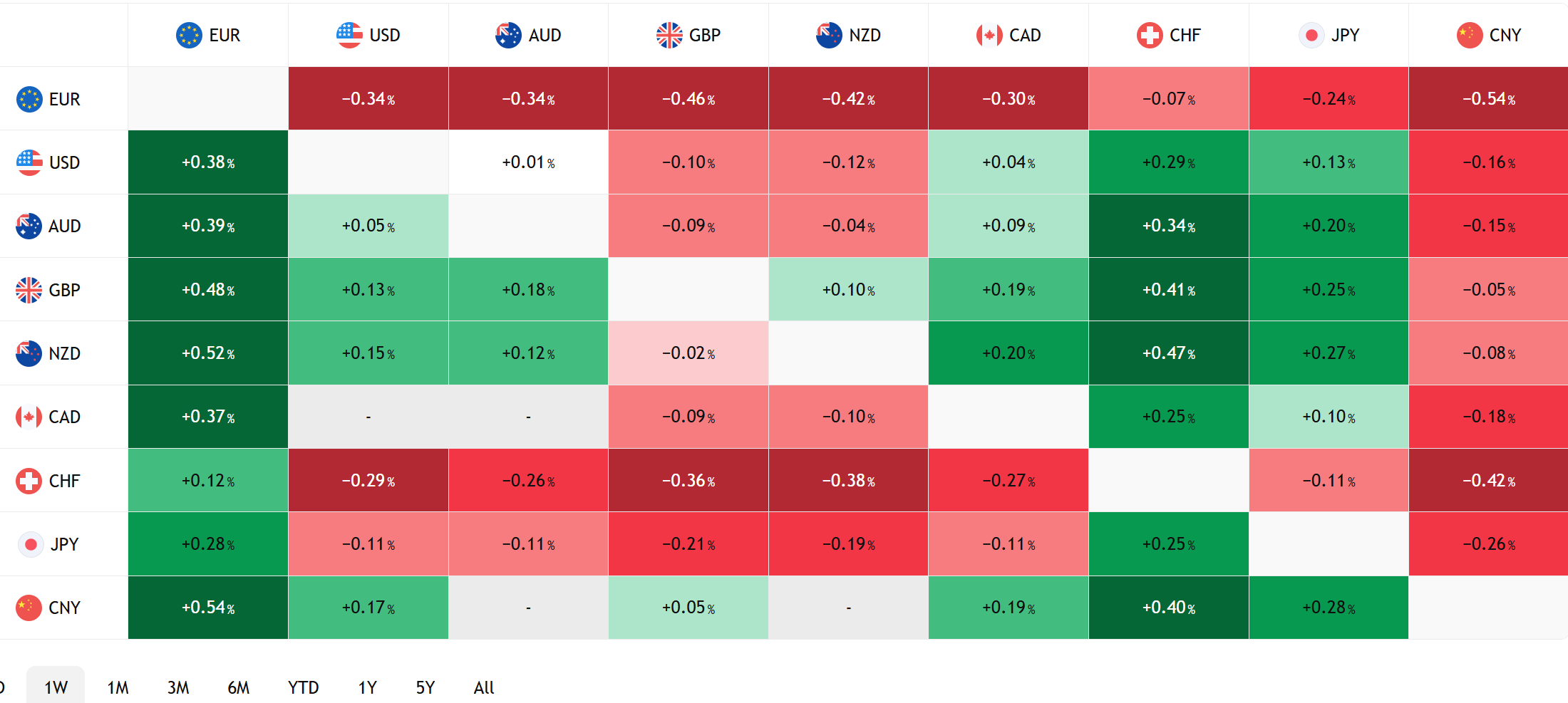
FX Heat Map
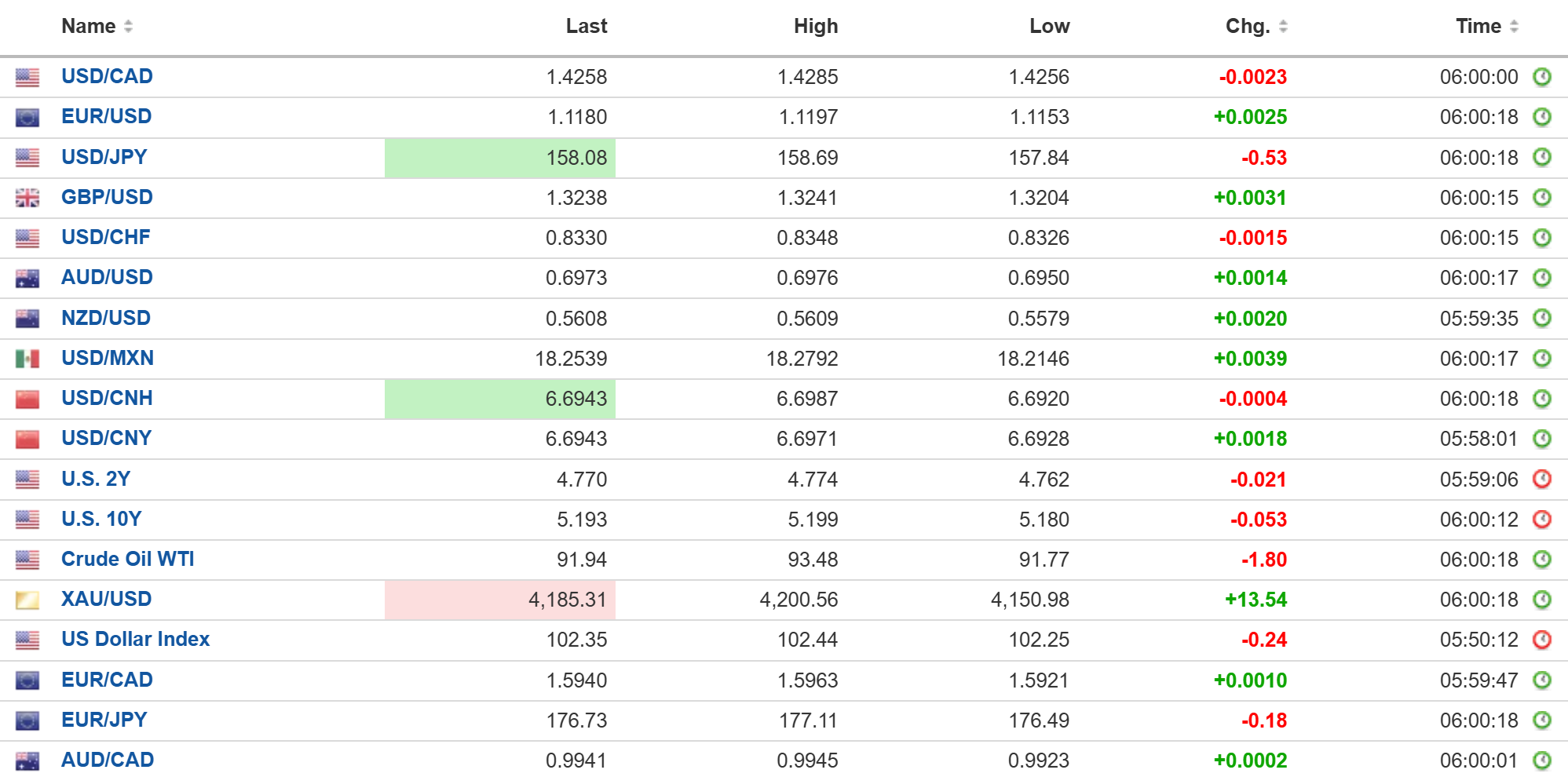
FX open high low 6:00 am
Equities Setting the Tone
Q3 earnings season kicks off today when JPMorgan announced its earnings and revenue rose 8.0%. It wasn’t enough for investors, and the stock is lower in pre-market trading. Goldman Sach’s posted its second best quarter in history and Citigroup earnings jumped 40%. The hawkish Fed rate outlook was reinforced again yesterday when Cleveland Fed President Beth Hammack said rates need to be higher.
Taking Stock
Asia closed with small gains led by a 0.30% rise in the Hong Kong Hang Seng. Japan’s Topix rose 0.14% while Australia’s ASX 200 was unchanged.
As of 5:30 am PT, the UK FTSE 100 has gained 0.47% which is off its best level today while the French CAC-40, the German Dax and S&P 500 futures are flat. The 10-year Treasury yield is 5.191%, the US Dollar Index is at 102.26, and gold (XAUUSD) is at $4,185.14.
EURUSD | Range 1.1153-1.1197
EURUSD is recovering from a multi-month low but struggling to break above 1.1200 as the French fiscal turmoil remains a major headwind. French government debt exceeds €3.5 trillion, and the budget deficit is well above the EU’s 3% limit. Parliamentary budget debates begin today, offering little reassurance that France’s political divisions will produce a credible fiscal fix. Speculative positioning adds to the pressure, with euro net shorts at their largest since 2020. German September inflation was confirmed at 3.3% y/y and 0.6% m/m but was not a factor for traders.
GBPUSD | Range 1.3204-1.3241
GBPUSD rallied on the back of stronger-than-expected UK retail sales, with BRC sales rising 1.0% against a 0.7% forecast, and Prime Minister Andy Burnham’s plan to open a “serious dialogue” with EU officials, claiming the status quo is not good enough. BoE hawk Megan Greene and Governor Andrew Bailey have different views on how to ensure price stability, which is keeping November rate hike expectations alive.
USDJPY | Range 157.84-158.69
USDJPY is rallying despite a drop in crude oil prices. The gains are fuelled by recent dovish-sounding comments from Bank of Japan officials, including Governor Ueda, that leaned against an October hike, contrasted by market expectations for the Federal Reserve to raise interest rates in December. Japan’s wholesale inflation cooled to 6.8%, while household spending fell 3.1% in August. This marks the eighth consecutive monthly decline, signalling severe underlying weakness in consumer demand and further justifying the central bank’s cautious approach to tightening.
AUDUSD | Range 0.6950-0.6989
AUDUSD is squeezing out gains on the back of improved risk sentiment, a retreat in global bond yields, particularly Treasuries, a modestly weaker US dollar and hawkish RBA minutes. Policymakers were concerned with upside inflation risks from higher oil, AI-driven costs, and tight domestic capacity. The minutes warned that timely action was needed to anchor expectations, and markets priced in more rate hikes by mid-2027.
USDMXN | Range 18.2146-18.2792
USDMXN remains highly rangebound as it consolidates recent gains. The potent combination of a dovish-to-neutral Banxico policy stance contrasting against a persistent hawkish Fed bias continues to support the US dollar while narrowing the carry-trade yield advantage. Adding to this monetary friction is deep-seated uncertainty surrounding impending US-Mexico trade negotiations under the upcoming USMCA review.
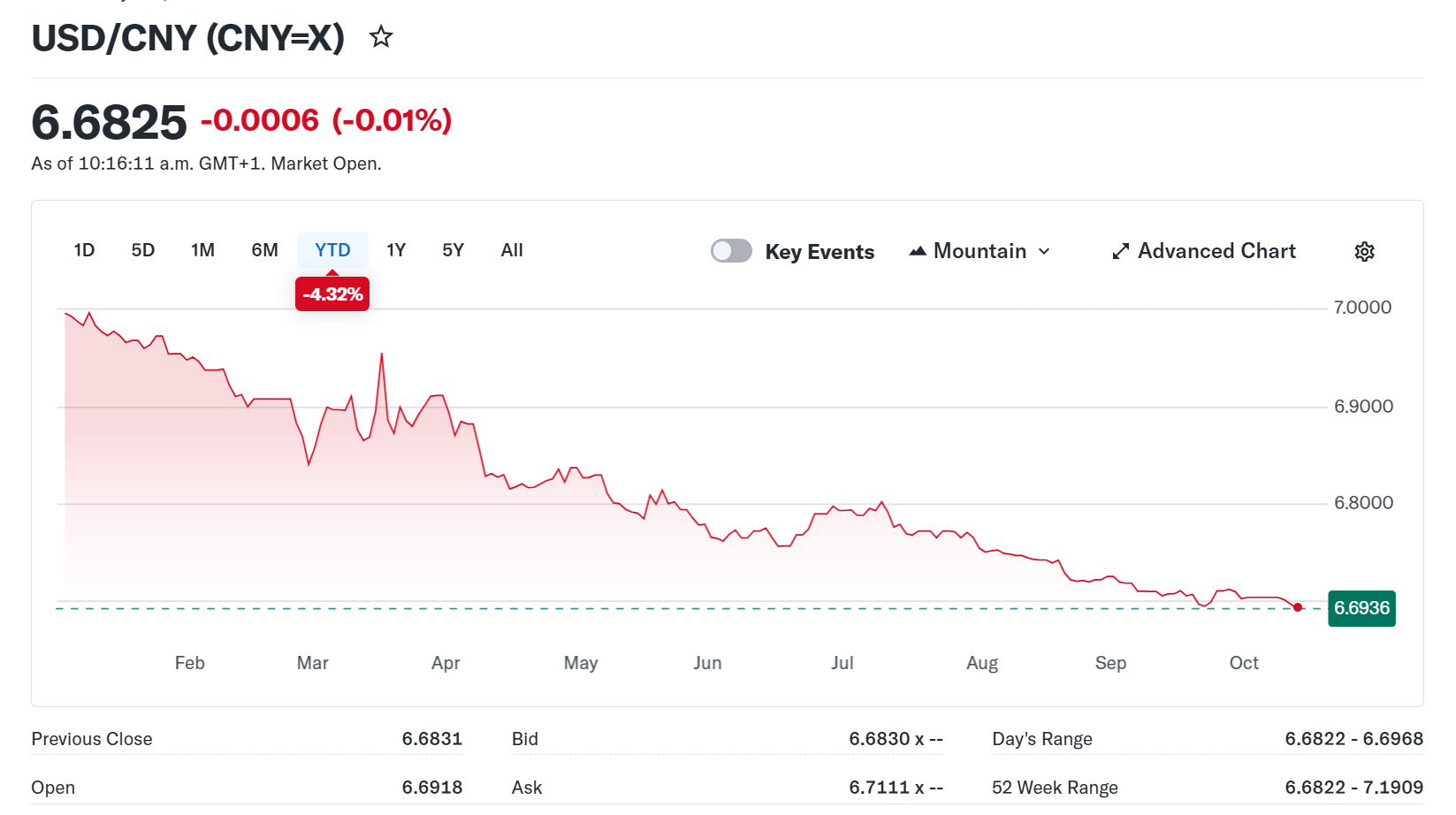
CHINA
PBoC Fix: 6.7298 vs exp. 6.6981
Shanghai Shenzhen CSI 300 fell 0.29% to 4,275.68 (Tuesday) Monday-CSI 300 fell 0.68% to 4287.98.
China announced it will reduce the value-added tax (VAT) export rebate rate for new energy vehicles from 13% to 9%, effective April 1, 2027 (prev. 6.7313)
Sources: Investing.com, Bloomberg, Reuters, Yahoo Finance, US Census Bureau, Trading Economics, Tradingview